


The way people find information online has fundamentally shifted. Traditional search engines are evolving into intelligent answer engines, and websites must adapt to remain visible. Understanding how to optimize your website for AI search is no longer optional–it’s essential for maintaining digital relevance.
Definition: AI SEO and AIO
AI Search Optimization (AIO) represents the next evolution of digital visibility. Unlike traditional SEO, which focuses on ranking among a list of blue links, AIO ensures your content becomes the primary source cited in AI-generated responses. Answer Engine Optimization works alongside Generative Engine Optimization (GEO) to position your website as the authoritative voice AI tools reference when answering user queries.
The distinction matters because AI doesn’t just rank content–it synthesizes information from multiple sources to create comprehensive answers. Your goal shifts from securing the top position to becoming a recognized authority that AI models trust and cite.
LLM SEO and Generative Engine Optimization (GEO)
Large Language Model optimization, which is deeply connected to semantic SEO strategies, differs significantly from conventional search strategies. While traditional SEO targets specific keywords and backlink profiles, GEO focuses on visibility within AI-generated snapshots and conversational responses. Generative engine optimization ensures your content appears when AI tools like ChatGPT, Perplexity, or Google’s Search Generative Experience compile answers.
These AI systems don’t simply crawl and rank–they interpret, synthesize, and attribute. Your content must be structured in ways that help these models understand context, extract facts accurately, and recognize your site as a credible source.
Importance for Marketers and Business Owners
The digital landscape now serves two audiences: human readers and AI agents. According to recent industry data, over 40% of searches now generate AI-powered results, fundamentally changing how users discover information. Businesses that fail to adapt risk becoming invisible to an increasingly AI-mediated audience.
This shift affects every industry. E-commerce sites must ensure product information feeds into AI shopping assistants. Service providers need their expertise recognized when AI tools recommend solutions. Publishers require their content cited when answering complex queries. The common thread? AI visibility directly impacts brand awareness and customer acquisition.
AI Visibility vs. Organic Traffic
Traditional metrics like click-through rates tell only part of the story. In the AI era, “brand share of model” becomes crucial–how often does an AI cite your brand compared to competitors? A citation may not generate an immediate click, but it establishes authority and drives awareness among users who trust AI recommendations.
Data suggests that citations in AI responses correlate with increased branded searches and higher conversion rates from users who eventually visit your site. The relationship between AI visibility and organic traffic isn’t zero-sum; citations often complement traditional search traffic by building trust before users click.
Mechanics: How AI Search Functions
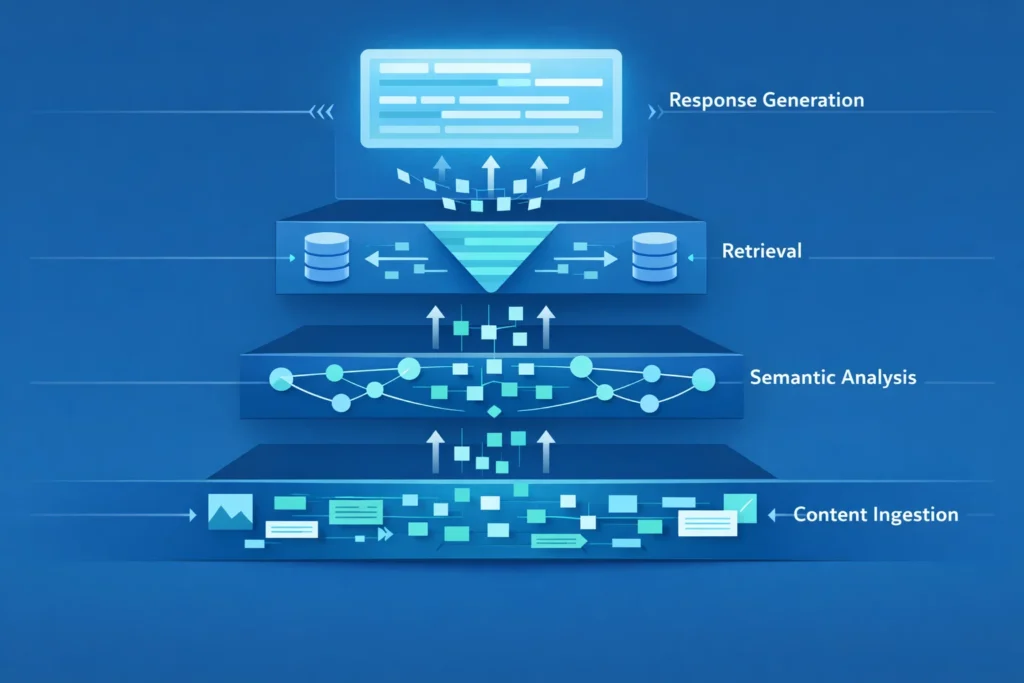
Understanding the technical foundation helps you optimize effectively. Modern AI search systems operate differently from traditional crawlers, requiring specific technical and content considerations.
Large Language Models and Information Retrieval
AI search engines employ sophisticated processes to deliver answers. They scrape web content, tokenize information into digestible units, and retrieve relevant data to construct natural language responses. Unlike keyword-based crawlers, LLMs analyze semantic meaning, contextual relationships, and source credibility simultaneously.
The process involves:
- Content discovery through specialized AI crawlers
- Information extraction and semantic analysis
- Fact verification against multiple sources
- Response generation with attribution
Your content must be structured to facilitate each stage. Clear hierarchies, factual accuracy, and explicit sourcing improve the likelihood of proper interpretation and citation.
Recognition over Ranking
AI systems prioritize topical authority over link quantity. While backlinks remain relevant, being recognized as a definitive source on specific topics carries more weight. AI models evaluate expertise signals–author credentials, content depth, citation frequency across the web–to determine which sources deserve prominence in generated answers.
This shift rewards genuine expertise over optimization tactics. A well-researched article from a recognized expert often outperforms a heavily linked but superficial piece. The focus moves from gaming algorithms to demonstrating real knowledge.
Conversations replacing Keywords
Users interact with AI search differently than traditional engines. Instead of typing “best running shoes,” they ask “what running shoes would work best for someone with flat feet training for a marathon?” This conversational approach requires content that addresses specific, nuanced questions rather than broad keyword terms.
AI models excel at interpreting these natural language queries, understanding user intent beyond surface keywords. Your content strategy must account for the full spectrum of questions your audience might ask, providing comprehensive answers that satisfy conversational search patterns.
Evolution: AI Search vs. Traditional SEO
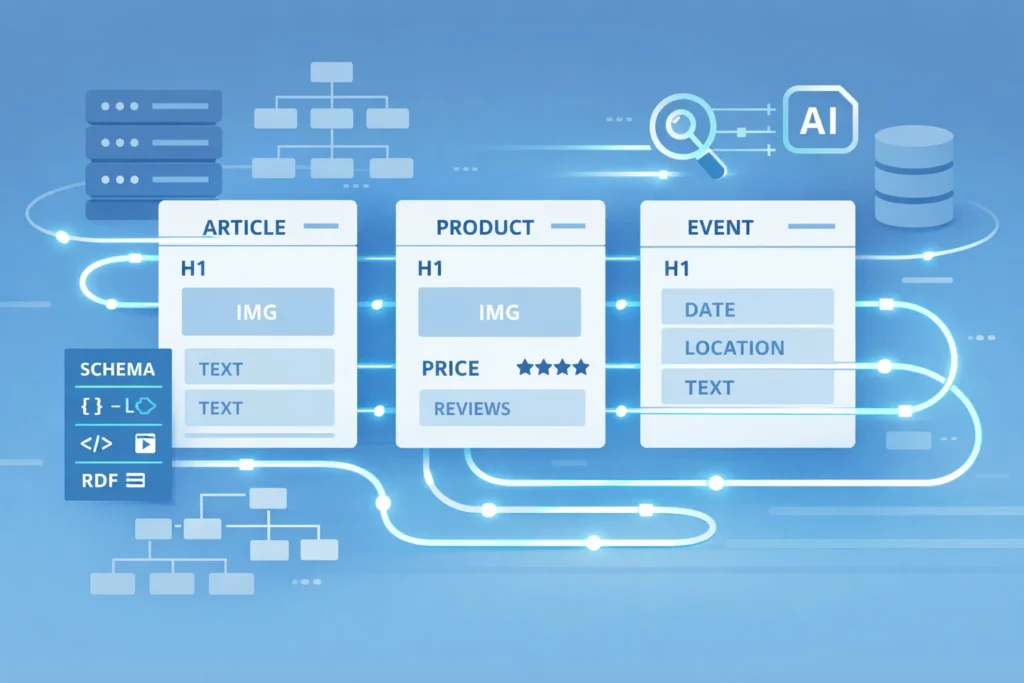
The fundamentals haven’t disappeared–they’ve been augmented. Understanding what remains constant helps you build on existing efforts rather than starting from scratch.
Persistent SEO Fundamentals
Core technical factors still matter significantly. Mobile responsiveness, page speed, and core web vitals form the baseline that AI crawlers expect, which is why a technical SEO audit remains a top priority. A slow, poorly structured website remains problematic regardless of content quality. These technical foundations ensure AI bots can efficiently access and process your information.
Clean code, logical site architecture, and proper XML sitemaps continue serving their original purpose while supporting AI discovery. The technical excellence that benefited traditional SEO creates the accessibility AI systems require.
Trust over Clicks
AI engines evaluate source reliability before citing content. Unlike traditional algorithms that might reward engagement metrics regardless of accuracy, AI systems prioritize trustworthy information. Clickbait headlines and sensationalized content actively harm your chances of being cited, as models detect and deprioritize unreliable sources.
Trust signals include:
- Consistent factual accuracy across your content
- Transparent sourcing and citations
- Author credentials and expertise indicators
- Positive reputation across the broader web
Building trust takes time but pays dividends as AI models increasingly weight reliability in their selection criteria.
Discovery Queries and User Intent
AI excels at understanding why someone searches, not just what they’re searching for. The technology maps queries to specific stages of the buyer’s journey, delivering tailored information based on user intent. A query like “how does email marketing work” receives educational content, while “best email marketing platforms for small businesses” triggers comparison and recommendation responses.
Your content must address intent explicitly. Answer the underlying question, provide context, and guide users based on where they are in their decision process. This alignment between content and intent increases the likelihood of AI selecting your material as relevant.
Technical Preparation for AI Crawlers
Ensuring your site is technically ready for AI discovery requires specific configurations beyond traditional SEO.
Ensuring Bot Accessibility for LLMs
AI crawlers like GPTBot, Google-Extended, and others use specific user agents to access content. Your robots.txt file must balance protecting proprietary data with allowing AI discovery. Blocking all AI crawlers guarantees obscurity, while unrestricted access might expose sensitive information.
Consider implementing selective access:
- Allow AI crawlers to access public-facing educational content
- Restrict proprietary tools, internal documentation, or competitive data
- Monitor crawler behavior through server logs
This strategic approach maximizes visibility while protecting valuable assets.
Solid Technical Foundations
AI models struggle with poorly structured websites, so whether you choose a custom build or are weighing the pros and cons of a pre-built site, clean code is a must. Messy code or confusing architecture can lead to misrepresentation or complete omission from AI responses.
Technical checklist for AI readiness:
- Implement semantic HTML with proper heading tags
- Ensure all pages are accessible via a logical URL structure
- Create and maintain an updated XML sitemap
- Fix broken links and redirect chains that confuse crawlers
- Optimize for mobile devices, as many AI searches originate on phones
These foundational elements create the infrastructure AI needs to accurately crawl and understand your site.
Internal Context and Link Architecture
Internal linking serves a dual purpose in the AI era. It helps users navigate your site while teaching AI models how your content relates. Strategic internal links create a semantic web that demonstrates topical clusters and expertise depth.
When linking internally:
- Use descriptive anchor text that explains the linked content’s value
- Connect related topics to show comprehensive coverage
- Create hub pages that aggregate expertise on core subjects
- Ensure important pages receive multiple internal links
This architecture helps AI understand your site’s topical authority and the relationships between different content pieces.
Strategic Content Optimization for LLMs
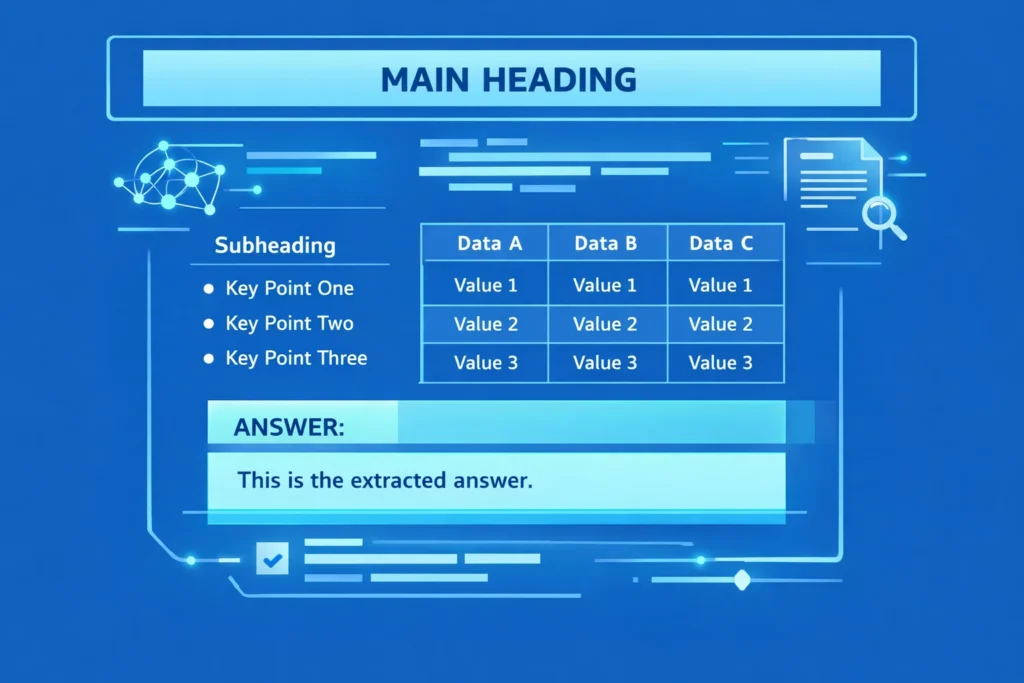
Creating content that resonates with both AI and human audiences requires specific techniques that go beyond keyword insertion.
Clear Content Structure and Formatting
AI models parse content more effectively when it follows logical hierarchies. Descriptive H2 and H3 headings act as signposts, helping AI understand content organization and extract relevant information. Bulleted lists present facts in easily digestible formats that AI can reference accurately.
Structure your content with:
- Clear, descriptive headings that summarize section content
- Short paragraphs that focus on single ideas
- Bulleted lists for steps, features, or comparative points
- Tables for data that benefits from structured presentation
This formatting improves both AI comprehension and human readability–a rare win-win in optimization.
Unique, Helpful, and Citational Material
AI systems prioritize original sources over derivative content. Publishing unique research, proprietary data, or novel perspectives significantly increases citation probability. When multiple sites cover the same topic, AI favors the original source or the most comprehensive treatment.
Focus on creating content that:
- Presents original research, surveys, or case studies
- Offers expert analysis not available elsewhere
- Cites primary sources to establish credibility
- Provides depth that goes beyond surface-level coverage
Original content not only attracts AI citations but also positions your brand as a thought leader in your industry.
Writing for Questions and Human Readers
The inverted pyramid structure works exceptionally well for AI optimization. Answer the main question immediately, then provide supporting details and context. This approach satisfies AI’s need for quick, accurate answers while keeping human readers engaged.
Implement this by:
- Leading with direct answers to the primary query
- Following with explanation and context
- Providing examples and applications
- Offering related information for deeper exploration
This structure ensures AI can extract accurate answers while giving human readers a complete, satisfying experience.
Authority and Trust Signals in AI Era

Establishing expertise has always mattered, especially when trying to get a Google Knowledge Panel, but AI systems now evaluate these authority signals with particular scrutiny.
Strengthening Expertise and E-E-A-T
Experience, Expertise, Authoritativeness, and Trustworthiness (E-E-A-T) directly influence AI citation decisions. Demonstrating these qualities requires explicit signals that both humans and AI can recognize.
Strengthen E-E-A-T through:
- Detailed author bios with relevant credentials
- Transparent disclosure of sources and methodology
- Regular content updates to maintain accuracy
- Expert contributors with verifiable backgrounds
These signals help AI determine whether your content represents genuine expertise or superficial coverage.
Building Brand Identity
A strong, consistent brand presence across the web makes your site easier for AI to identify as authoritative. When your brand appears in multiple contexts–news articles, industry publications, social platforms–AI models recognize you as a significant player in your field.
Brand building strategies include:
- Consistent brand voice and messaging across all platforms
- Active participation in industry discussions and forums
- Regular publication of high-quality content
- Engagement with your audience and community
This multi-platform presence reinforces your authority in AI training data and real-time search contexts.
Third-Party Mentions and Community Presence
Off-page signals matter significantly in AI optimization. Mentions in reputable forums, Reddit discussions, or news articles validate your expertise to LLMs. These external references act as “votes of confidence” that AI systems consider when evaluating source credibility.
Build external presence by:
- Contributing expert insights to industry publications
- Participating authentically in relevant online communities
- Earning coverage in reputable news sources
- Creating shareable resources that others naturally reference
Quality matters more than quantity–a single mention in a highly authoritative publication carries more weight than dozens of low-quality citations.
Tactics for AI Citations

Specific tactical approaches can increase your likelihood of being cited in AI-generated responses.
Factuality and Authoritative Sourcing
Factual accuracy is non-negotiable in the AI era. Models increasingly verify claims against multiple sources, and inaccuracies can trigger “hallucination” flags that damage your credibility. Every claim should be accurate and, where possible, sourced from authoritative references.
Ensure factuality by:
- Citing primary sources for statistical claims
- Linking to authoritative references for technical information
- Regularly auditing content for accuracy
- Correcting errors promptly when discovered
This rigorous approach to truth builds the trust AI systems require before citing your content.
Schema Markup and Metadata Implementation
Structured data acts as a translation layer between your content and AI understanding. Schema markup provides explicit context about your content’s meaning, making it easier for AI to extract accurate information. JSON-LD schema helps AI understand whether you’re discussing a product, service, person, or concept.
Priority schema types for AI optimization:
- Article schema for blog posts and guides
- Product schema for e-commerce offerings
- FAQ schema for common questions
- How-to schema for instructional content
This structured data creates a “cheat sheet” that dramatically improves AI comprehension and citation accuracy.
Building Mentions Across Web
Strategic PR and guest posting that focuses on entity association helps AI connect your brand with specific topics. When authoritative sources mention your brand in context with relevant keywords, AI models strengthen the association between your expertise and those subjects.
Effective mention-building strategies:
- Guest post on high-authority sites in your industry
- Provide expert quotes for journalist requests
- Participate in podcasts and webinars that get transcribed
- Create original research that others cite
These activities build the web of associations that AI uses to determine topical authority.
Niche-Specific AIO Strategies
Different business models require tailored approaches to AI optimization.
Optimizing Ecommerce Sites for AI Search
Product discovery increasingly happens through AI assistants that compare features, prices, and reviews. E-commerce sites must ensure product information is structured for AI interpretation. Product schema, customer reviews, and detailed specifications help AI accurately represent your offerings in comparison queries.
E-commerce optimization priorities:
- Implement comprehensive product schema markup
- Encourage and display authentic customer reviews
- Create detailed product descriptions with specifications
- Develop comparison guides and buying advice content
AI often assists in the research and comparison phase, making it crucial that your products appear accurately in these contexts.
Growing Service-Based Businesses via AIO
Service providers benefit from solution-oriented content that addresses specific client problems. AI handles “near me” queries and service recommendations by evaluating local authority signals, review quality, and content depth. Combining local SEO with AI optimization creates powerful visibility for service businesses.
Service business tactics:
- Create comprehensive service pages that answer common questions
- Develop case studies demonstrating expertise
- Maintain accurate business information across platforms
- Generate content addressing specific client pain points
This approach positions your business as the logical solution when AI recommends services in your category.
Measurement and Performance Tools
Traditional metrics don’t capture the full picture of AI optimization success.
AI Website Optimization Tools
Specialized tools now help audit AI readiness and track AI visibility. Platforms that simulate LLM responses or analyze semantic density provide insights beyond traditional SEO metrics. These tools help identify opportunities to improve AI discoverability and citation frequency.
Categories of AI optimization tools:
- Semantic analysis platforms that evaluate topical authority
- AI citation trackers that monitor brand mentions in AI responses
- Technical audit tools that check AI crawler accessibility
- Content optimization software that suggests improvements for LLM readability
Integrating these tools into your workflow provides the data needed to refine your AI optimization strategy.
Auditing Website for AI Readiness
Regular audits ensure your site remains optimized as AI technologies evolve. A comprehensive AI readiness audit evaluates technical accessibility, content quality, authority signals, and structured data implementation.
Audit checklist:
- Verify AI crawler access through robots.txt
- Review schema markup implementation and accuracy
- Assess content structure and formatting
- Evaluate E-E-A-T signals and author credentials
- Check technical performance and mobile optimization
Running these audits quarterly helps maintain AI visibility as algorithms and best practices evolve.
Performance Metrics Beyond SEO
New KPIs capture AI-specific performance:
- Brand Mention Volume: How frequently AI cites your brand
- Citation Share: Your citations compared to competitors
- Sentiment Analysis: The context in which AI mentions your brand
- AI-Driven Traffic: Visitors who discovered you through AI recommendations
These metrics complement traditional analytics, providing a complete picture of digital visibility across both human and AI-mediated discovery.
FAQ: Common AI Optimization Queries
Define AI SEO Optimization
AI SEO optimization adapts traditional search strategies for answer engines that synthesize information rather than simply ranking pages. It focuses on becoming a cited source in AI-generated responses rather than achieving top positions in search results.
Steps to Optimize Website for AI Search
A practical implementation checklist:
- Ensure AI crawlers can access your content
- Implement comprehensive schema markup
- Create original, authoritative content with clear structure
- Build expertise signals through author credentials and citations
- Monitor AI citations and refine based on performance
Generative Engine Optimization (GEO) Explained
GEO differs from traditional optimization by targeting real-time generative responses rather than static rankings. While SEO focuses on where you appear in results, generative engine optimization ensures AI systems recognize and cite your expertise when constructing answers.
Value of AI Citations
Citations drive high-intent traffic from users who trust AI recommendations. Data indicates that users discovering brands through AI citations demonstrate higher conversion rates and stronger brand affinity compared to traditional search traffic. Citations build long-term authority that compounds over time.
Final Thoughts: Future of Search
AI search evolves rapidly, with new capabilities and models emerging regularly. The strategies outlined here provide a foundation, but staying current requires ongoing adaptation. Focus on fundamentals–authoritative content, technical excellence, and genuine expertise–that remain valuable regardless of technological shifts.
The most future-proof approach centers on creating genuinely helpful, accurate information for human readers. AI systems increasingly reward content that serves users well, making quality the ultimate sustainable strategy. As AI becomes more sophisticated in evaluating content, the gap between optimization tactics and genuine value continues to narrow.
Businesses that embrace this shift, viewing AI as a new channel for demonstrating expertise rather than an obstacle to overcome, position themselves for sustained visibility in an AI-mediated digital landscape.