
Search engines process over 8.5 billion queries daily, and your website’s ability to appear in those results depends heavily on factors you control directly. On-page SEO represents the foundation of any successful organic visibility strategy, encompassing everything from HTML markup to content quality and user experience signals.
This comprehensive checklist distills years of experience into actionable steps that help search engines understand your content while satisfying user intent.
On-Page SEO Basics and Business Value
On-page SEO is the practice of optimizing individual web pages to rank higher in search engine results and attract more relevant traffic. Unlike off-page factors such as backlinks, on-page optimization involves elements you control completely. While many businesses choose professional On-Page SEO Services to handle the heavy lifting, the core focus remains on content quality, HTML structure, internal linking, and technical performance.
Core distinctions in SEO approaches:
- On-page SEO focuses on content and HTML elements: title tags, header structure, body content, alt text, and internal links
- Off-page SEO involves external signals like backlinks and brand mentions you cannot control directly
- Technical SEO addresses backend infrastructure: site speed, mobile-friendliness, crawl budget, robots.txt, and Core Web Vitals
In 2026, search engines prioritize pages demonstrating clear expertise and aligning with search intent. Primary objectives include helping search engine bots discover and index content, communicating relevance through keyword placement, and creating experiences keeping visitors engaged.
On-Page SEO Goals
The primary objectives of on-page optimization include helping search engines crawl and categorize content efficiently, improving user experience through fast load times and intuitive navigation, and aligning page elements with specific search queries. Each goal reinforces the others – when you optimize your content for relevance, you simultaneously improve user experience, which sends positive engagement signals that search engines interpret as quality indicators.
Differences Between On-Page, Off-Page, and Technical SEO
On-page SEO focuses on content and HTML elements visible to users and search engines and users. This includes title tags, header structure, body content, alt text, and internal links – all on-page factors you control directly.
Off-page SEO involves external signals like backlinks, brand mentions, and social proof. While you can influence these through outreach and content quality, you cannot control them directly as off-page factors operate independently.
Technical SEO addresses backend infrastructure: site speed, mobile-friendly design, crawl budget optimization, robots.txt configuration, and Core Web Vitals. Technical issues create the foundation, but they operate separately from on-page content optimization.
Phase 1: Technical SEO Foundation and Site Architecture
Before diving into content optimization, ensure structural prerequisites support successful indexing. Even perfectly written content cannot rank if search engines cannot crawl the page efficiently or users encounter slow performance.
Essential architectural elements:
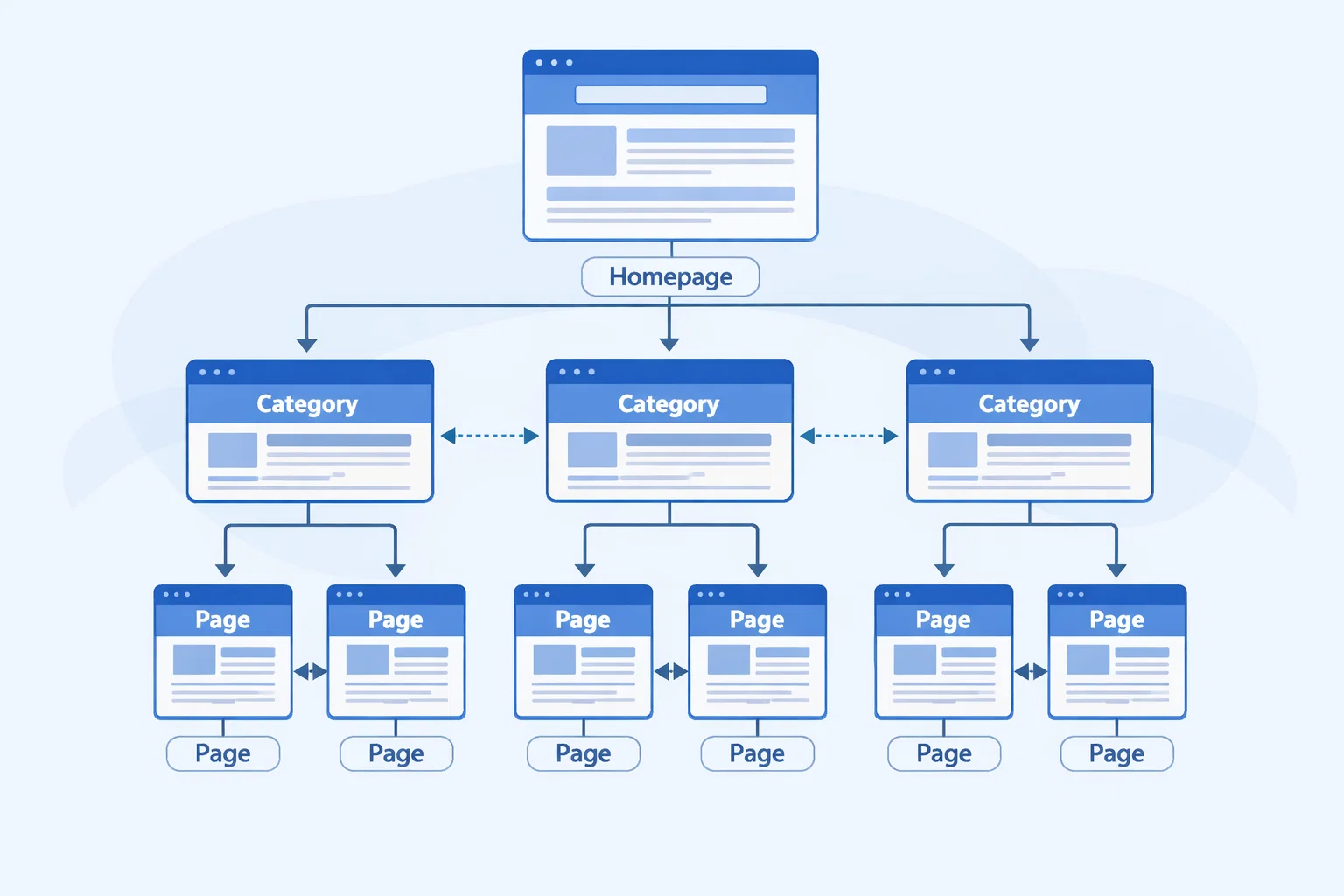
- Shallow depth: Keep pages no more than three clicks from homepage
- Logical hierarchy: Organize content reflecting user navigation patterns
- Clean URL paths: Use descriptive slugs indicating relationships
- Strategic connections: Link related content helping search engines understand topics
Site Structure Fundamentals
A well-planned site structure helps search engines understand your content hierarchy and allows link equity to flow efficiently. Ensure important pages sit no more than three clicks from your homepage, organize content into clear categories, use clean URL paths that indicate page relationships like example.com/marketing/seo/on-page-checklist, and connect related content through strategic internal linking.
When you audit your architecture, map how pages connect and identify orphaned pages lacking incoming internal links. This ensures every valuable page receives the crawl attention and ranking potential it deserves.
Performance Optimization and Core Web Vitals
Google’s Core Web Vitals measure real-world user experience based on performance data. The three essential metrics include Largest Contentful Paint measuring loading speed (aim for under 2.5 seconds), Interaction to Next Paint evaluating responsiveness to user interactions (target under 200ms), and Cumulative Layout Shift tracking visual stability during loading (keep below 0.1).
Check your Core Web Vitals report in Google Search Console to identify pages needing improvement. Fast load times are non-negotiable in 2026 as they directly impact both ranking potential and user satisfaction.
Mobile-Friendliness and Page Experience
With mobile-first indexing, Google primarily uses the mobile version of your content for ranking. Your checklist must ensure you know how to make your website ready for mobile first indexing, specifically verifying responsive design that adapts to various screen sizes and touch targets of at least 48×48 pixels to prevent misclicks, readable text without requiring zoom (minimum 16px font size), and no intrusive interstitials blocking content access.
Test how your webpage renders on smartphones and tablets. Pages frustrating mobile users will struggle to gain visibility regardless of desktop performance.
Phase 2: Keyword Research and Strategic Planning
Effective on-page optimization begins before you touch the page itself. You need clarity on what the content should rank for and what user intent it serves.
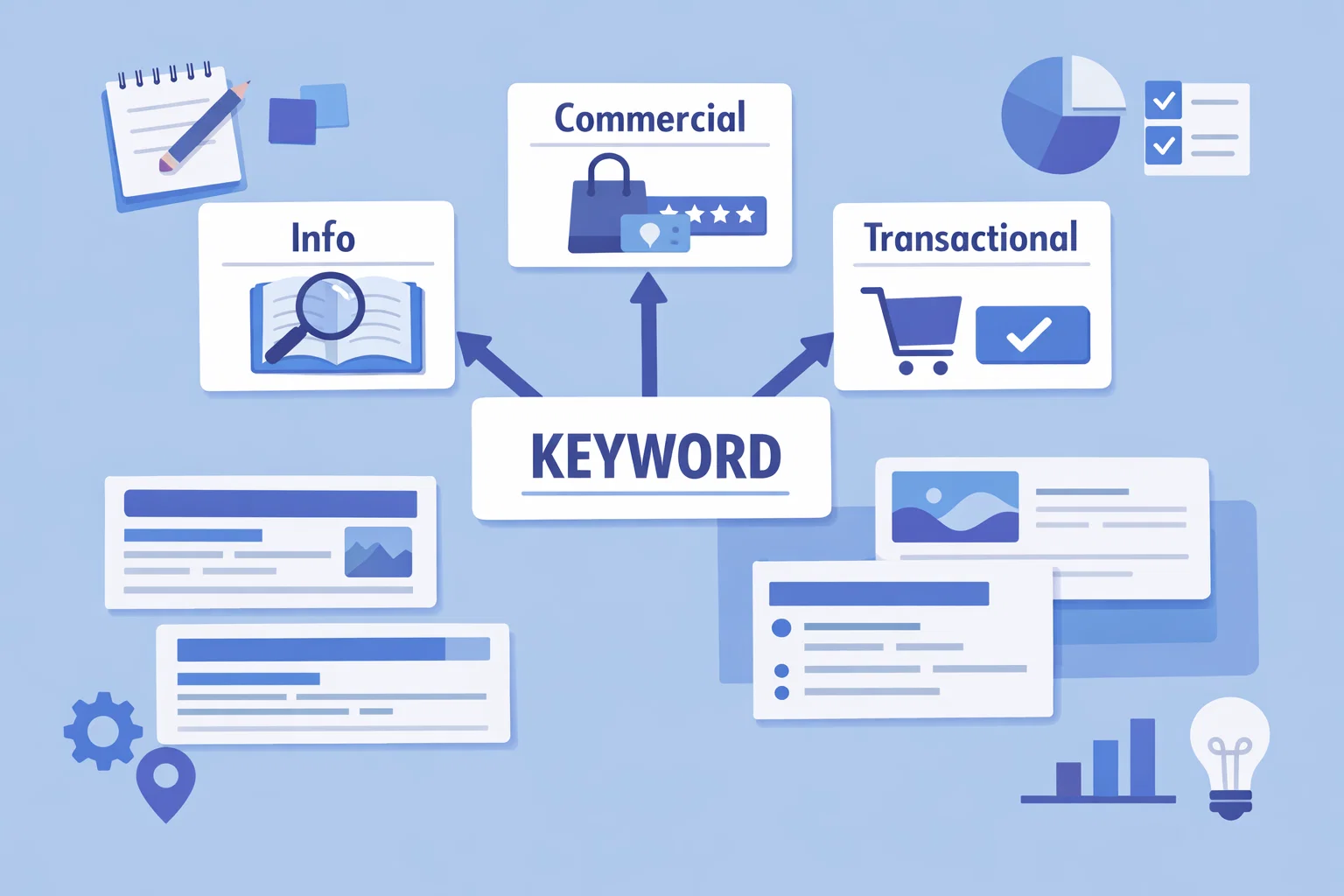
Intent categories guiding selection:
- Informational: Users seeking knowledge (“what is on-page SEO”)
- Navigational: Users finding specific sites (“Semrush login”)
- Commercial: Users researching solutions (“best SEO tools 2026”)
- Transactional: Users ready to act (“buy SEO audit service”)
Intent-Driven Keyword Analysis
Analyze your target keyword to determine which intent it serves – informational, navigational, commercial, or transactional. Then audit whether your existing on-page content matches that expectation. A page targeting “on-page SEO checklist” should provide a comprehensive, actionable list rather than a vague overview.
Understanding the user intent behind each keyword helps you structure your content to satisfy what users want when they appear in search results for that query.
Competitive Gap Analysis
Review the top 10 results in Google Search for your target keyword. Note which subtopics they cover that your page lacks. Use tools like Semrush to identify keywords and related terms that high-ranking competitors emphasize.
This analysis reveals content gaps representing optimization opportunities. If every top-ranking page discusses schema markup but yours doesn’t, that omission likely limits your competitiveness in the SERP.
Identifying Primary and Secondary Keyword
Select one main target keyword defining the page’s core topic. Then choose 3–5 supporting keywords providing semantic depth and helping search engines understand your content’s breadth.
For example, if your primary keyword is “on-page SEO checklist,” secondary keywords might include “meta description optimization,” “internal linking strategy,” and “header tags structure.” This creates topical relevance without forcing keywords unnaturally into your content.
Phase 3: Critical HTML Elements and Metadata Checklist
This section covers code-level elements communicating directly with search engine crawlers. Proper optimization ensures search engines correctly interpret your page’s purpose and present it effectively in search results.
Core metadata optimization points:
- Title tags under 60 characters with keywords near the front
- Meta descriptions 150–160 characters with value propositions
- Clean URL slugs using hyphens and primary keywords
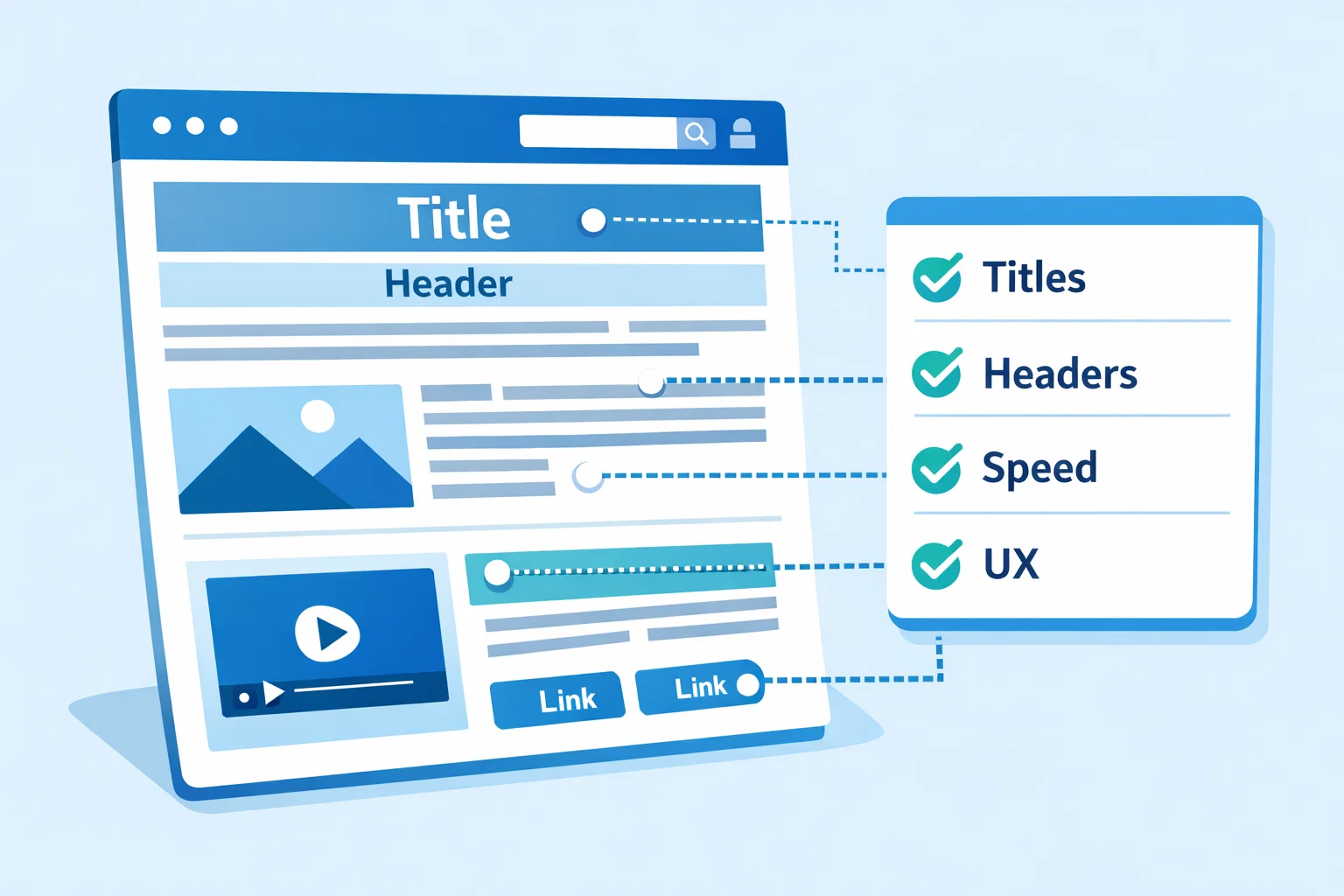
- Logical header structure with single H1 and nested H2–H6
Optimize Title Tags
The title tag appears as the clickable headline in search results and remains one of the most critical on-page factors. Your optimization checklist should verify the page title stays under 60 characters to prevent truncation, positions your target keyword near the beginning, ensures each page has a distinct title, and writes compelling copy encouraging users to click.
Example: “On-Page SEO Checklist: 47 Expert Tips for Higher Rankings (2026)” balances keyword inclusion with user appeal to improve click-through rate.
Write Meta Descriptions Boosting Clicks
While meta descriptions are not a direct ranking factor, they significantly influence click-through rate. Search engines may rewrite them based on the query, but a well-crafted page description improves your chances of appearing with your intended message.
Keep between 150–160 characters, include your primary keyword naturally, add a clear value proposition or call to action, and match the content’s actual focus. Your meta description should tell search engines and users what makes your content worth clicking over competing results.
Check URL Slugs for SEO-Friendliness
Clean URL structure helps both indexing and user trust. Audit your slugs to ensure they use hyphens (not underscores) to separate words, include the target keyword when possible, avoid dates or session IDs, and stay concise with typically 3–5 words.
Compare “example.com/blog/post-123456?ref=homepage” with “example.com/on-page-seo-checklist” – the second immediately communicates the page’s topic to both users and search engines.
Organize Content Using Header Tags
Headers create a hierarchical structure helping search engines understand content organization. Your audit should confirm one H1 per page mirroring or closely relating to your title tag, logical nesting using H2 for main sections and H3 for subsections without skipping levels, natural keyword inclusion in headers, and descriptive language that’s informative rather than generic.
Well-structured header tags act as a roadmap for both search engine bots and users scanning your content, making it easier to understand your content’s flow and relevance.
Phase 4: Content Quality and Structural Optimization
Content quality represents the core of on-page SEO work in 2026. Google’s helpful content systems evaluate whether pages demonstrate Experience, Expertise, Authoritativeness, and Trustworthiness (E-E-A-T).
Quality demonstration methods:
- Original insights based on real-world application
- Comprehensive information thoroughly addressing topics
- Citations referencing authoritative sources
- Author credentials establishing subject expertise
Content Quality Principles and E-E-A-T
Pages should provide well-researched, factual insights backed by authoritative sources. Include real-world examples, case studies, or expert perspectives enhancing credibility. Demonstrate first-hand experience through original data, proprietary research, or expert analysis that automated tools cannot replicate.
Focus on creating content providing perspectives or depth unavailable elsewhere. Pages simply restating common knowledge will struggle regardless of technical optimization.
Add Target Keywords to Body Content
Natural keyword integration remains important, but the approach has evolved. Ensure your primary keyword appears in the first 100 words, variations and synonyms appear throughout the content, keyword density stays below 2% to avoid stuffing, related terms create semantic connections, and keywords flow naturally within informative sentences.
Prioritize user comprehension over keyword frequency. Forcing keywords into awkward positions damages readability and triggers algorithmic penalties that hurt your ranking potential.
Detect Thin or AI-Generated Content
AI-generated content can serve as a starting point, but published pages need human refinement. Check for generic statements lacking specific details or examples, repetitive phrasing or circular logic, absence of original data or case studies, and surface-level coverage failing to address nuanced aspects.
Add unique value through personal experience, proprietary research, or expert analysis. This helps search engines and users differentiate your content from the flood of low-quality material appearing in search results.
Media Optimization and Alt Text
Images and videos enhance user experience and provide additional optimization opportunities. Your audit should verify descriptive file names like “on-page-seo-checklist-diagram.jpg” instead of “IMG_1234.jpg,” compressed files reducing size without sacrificing quality to improve load times, alt text providing clear, keyword-relevant descriptions for accessibility, and proper formats using WebP for photos and SVG for logos.
Add alt text that accurately describes the image while incorporating relevant keywords naturally. This serves both accessibility requirements and helps search engines understand visual content context.
Phase 5: User Experience and Engagement Optimization
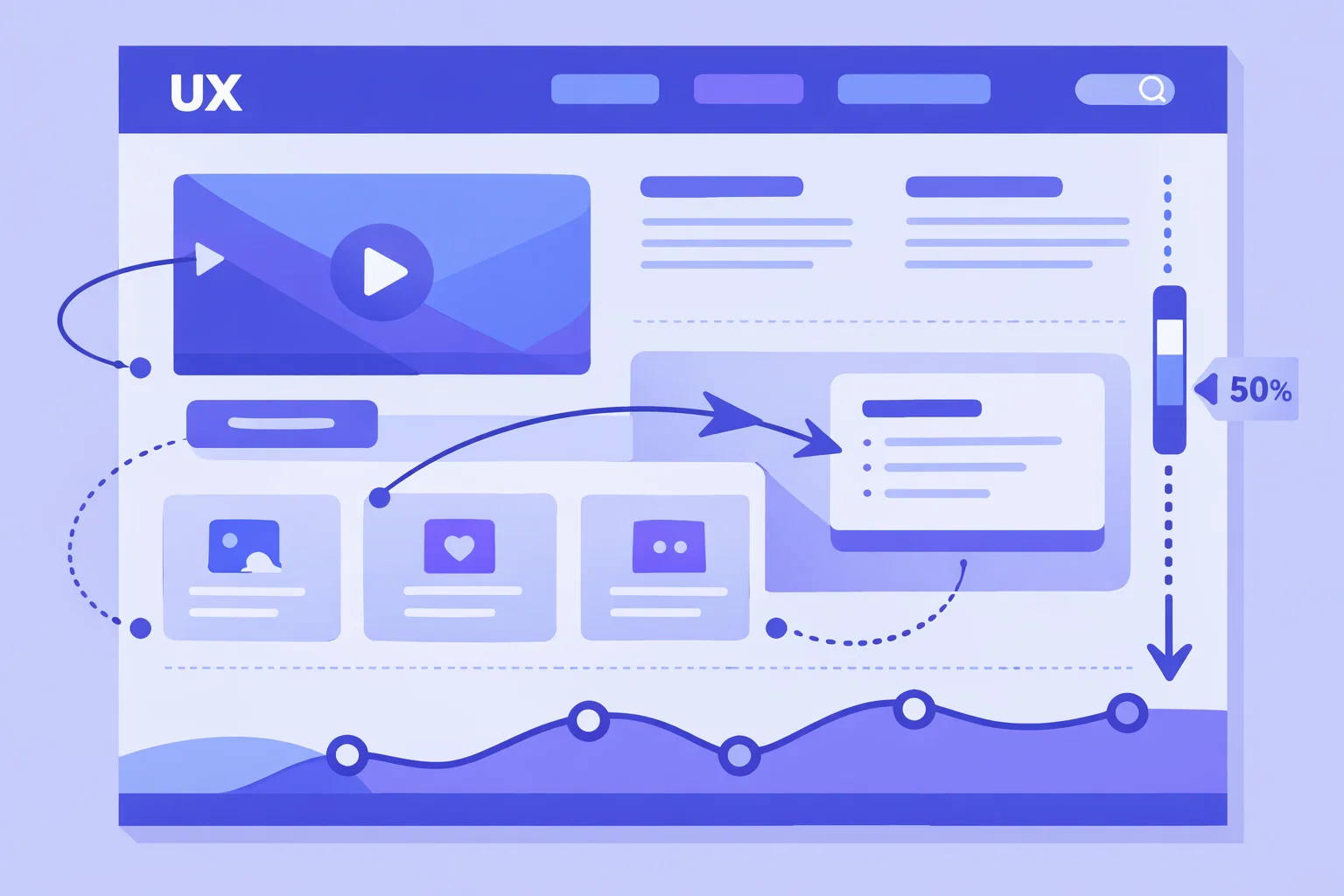
On-page optimization extends beyond keywords to encompass how users interact with your page. Search engines interpret engagement signals as quality indicators, making user experience a ranking factor.
Critical UX audit elements:
- Remove intrusive interstitials blocking content access
- Ensure adequate white space for comfortable reading
- Use visual hierarchy guiding attention effectively
- Make desired actions obvious without aggressive promotion
Interface and Navigation
A cluttered interface increases bounce rates and reduces time on page, sending negative signals to search engines about content quality. Check for intrusive interstitials (pop-ups) blocking content access especially on mobile, adequate spacing between elements, visual hierarchy using font sizes and colors to guide attention, and clear CTAs making desired actions obvious.
Clean design keeps users engaged longer, which search engines interpret as a signal that your on-page content satisfies the search intent effectively.
Improve Navigation with Internal Links
Strategic internal linking distributes link equity and helps search engines discover and understand your content. Your optimization should include contextual links embedded within body content where relevant, descriptive anchor text indicating the linked page’s topic, reasonable quantity of 2–5 internal links per 1,000 words, and balanced distribution linking to both popular and important deep pages.
Internal linking creates pathways keeping users engaged longer and helps search engines crawl your entire site efficiently, improving overall visibility.
Detect and Fix Orphaned Pages
Orphaned pages lack incoming internal links, making them nearly invisible to both crawlers and users. Run a site audit to identify pages with zero internal links, then add contextual links from relevant existing content, include them in category pages or resource lists, ensure they appear in your XML sitemap, and consider consolidating or removing low-value orphaned pages.
Every page worth indexing deserves at least one strong internal link from a well-crawled page to ensure search engine bots can discover and understand your content.
Phase 6: Advanced On-Page Techniques
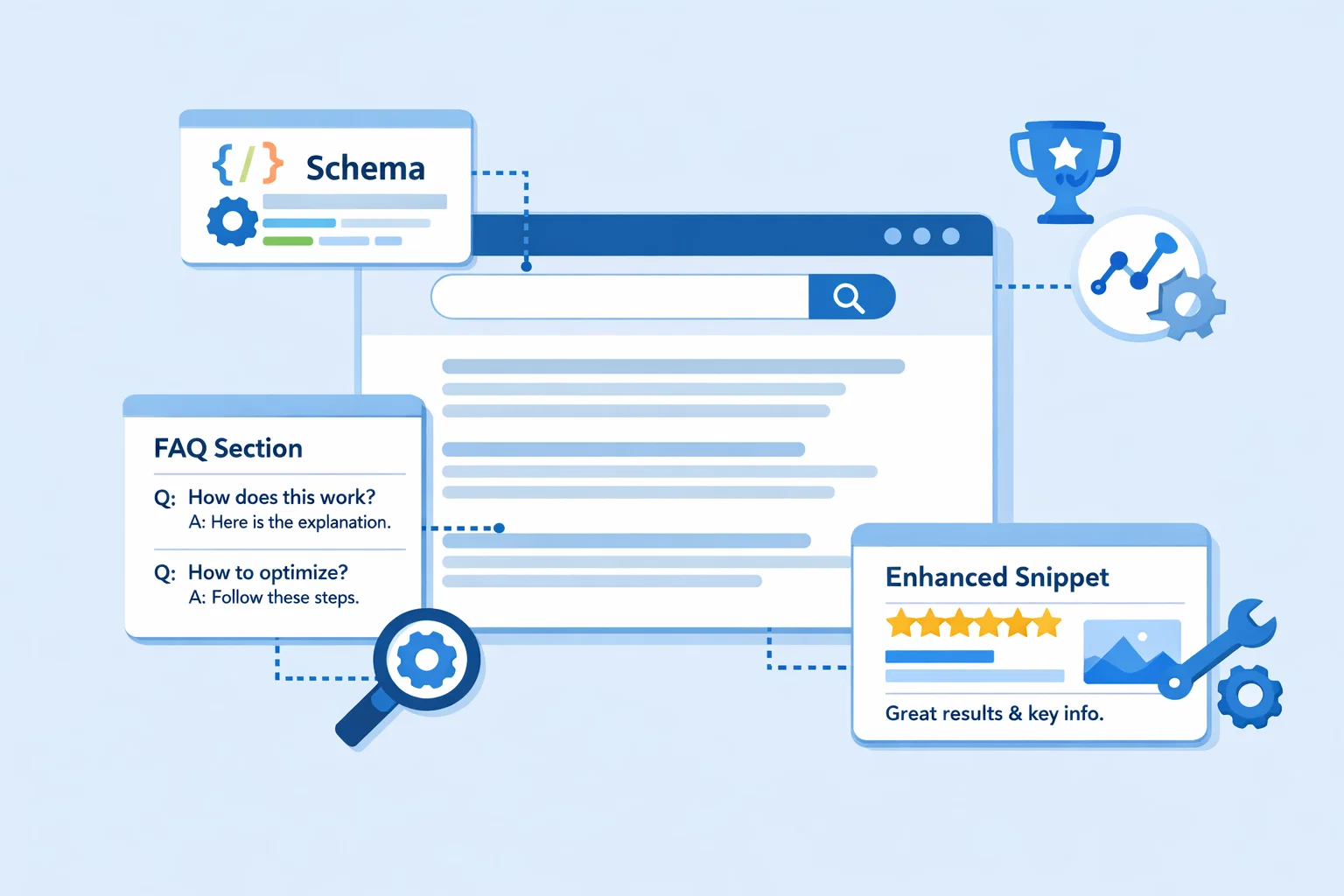
Beyond foundational optimization, advanced tactics provide competitive advantages in crowded SERPs. These strategies require more technical implementation but deliver measurable improvements in visibility.
Advanced implementation areas:
- JSON-LD structured data for rich snippets
- Interactive elements increasing engagement
- AI-powered competitive content analysis
- Semantic topic modeling and clustering
Applied Schema Markup
Structured data helps search engines understand your content’s context and enables rich snippet features. Common schema types for on-page content include Article (enhancing posts with publication dates and authors), FAQ (creating expandable question accordions in search results), HowTo (displaying step-by-step instructions with images), and Product (showing ratings, prices, and availability).
Implement schema using JSON-LD format and validate it with Google’s Rich Results Test. While not a direct ranking factor, structured data improves CTR by making your snippet more visually appealing.
Content Enhancement Strategies
Interactive elements keeping users on the page longer signal to search engines that your content satisfies user intent effectively. Add table of contents allowing users to jump to specific sections, key takeaway boxes highlighting main points for scanners, data visualizations presenting statistics in digestible formats, and embedded tools providing calculators or interactive assessments.
These enhancements reduce bounce rates and increase time on page, both positive engagement signals helping your ranking potential.
AI Competitive Benchmarking for SEO
Use AI tools to analyze semantic density and topical coverage compared to top-ranking competitors. This reveals subtopics competitors cover that your page omits, keyword variations improving topical relevance, content length benchmarks for comprehensive coverage, and structural patterns common among high-ranking pages.
Data-driven optimization based on competitive analysis helps you make your content more aligned with what search engines reward in your specific niche.
5 Effective Prompts for On-Page SEO Audits
These prompts–which are among the best chatgpt prompts for seo available today—work with AI assistants like ChatGPT or Gemini to streamline your optimization workflow. Copy and customize them for your specific needs.
Five ready-to-use audit prompts:
- Metadata analysis evaluating title and description effectiveness
- Content gap detection comparing header structure to competitors
- Internal link opportunity identification with anchor text suggestions
- Keyword density and natural language flow assessment
- Schema markup validation and rich snippet optimization
Prompt for Metadata Analysis
“Review this title tag and meta description for the keyword [your target keyword]. Evaluate: (1) keyword placement effectiveness, (2) character count compliance, (3) click appeal compared to competing results, (4) accuracy in representing the page content. Suggest three improved versions that balance optimization and user engagement.”
Prompt for Content Gap Detection
“Compare these header tags from my page: [list your H2s and H3s] against this competitor page: [competitor URL]. Identify topics they cover that I’m missing. Suggest 5 new subsections I should add to make my content more comprehensive without duplicating their structure.”
Prompt for Internal Link Suggestions
“Analyze this content block: [paste 200–300 words]. Suggest 3 internal linking opportunities with descriptive anchor text that would enhance topical relevance. For each suggestion, explain which type of page (category, related article, resource) would be the best linked page destination.”
Common On-Page SEO Mistakes and Solutions
Even experienced practitioners occasionally overlook critical elements. These red flags frequently appear during audits and can significantly limit ranking potential.
Common errors and fixes:
- Keyword stuffing with unnatural repetition exceeding 2% density
- Keyword cannibalization where multiple pages compete for same queries
- Missing or duplicate meta descriptions across pages
- Broken links damaging crawl efficiency and user trust
Keyword Stuffing and Over-Optimization
Symptoms include unnatural repetition of exact-match keywords, keyword density exceeding 2%, awkward phrasing to accommodate keyword variations, and lists of cities or services designed solely for search engines rather than users.
Solution: Rewrite content to prioritize natural language. Use synonyms and related terms creating semantic relevance without repetition. Focus on answering user questions comprehensively rather than hitting arbitrary keyword frequency targets that hurt readability.
Keyword Cannibalization Issues
Keyword cannibalization occurs when multiple pages on your site target the same search query, causing them to compete against each other. This splits ranking signals and confuses search engines about which page to prioritize.
Search your site using “site:example.com [your keyword]” in Google Search, identify pages that overlap in intent and target keywords, consolidate content into one authoritative page, or learn how to implement canonical tags to tell search engines exactly which version of the content they should prioritize.