

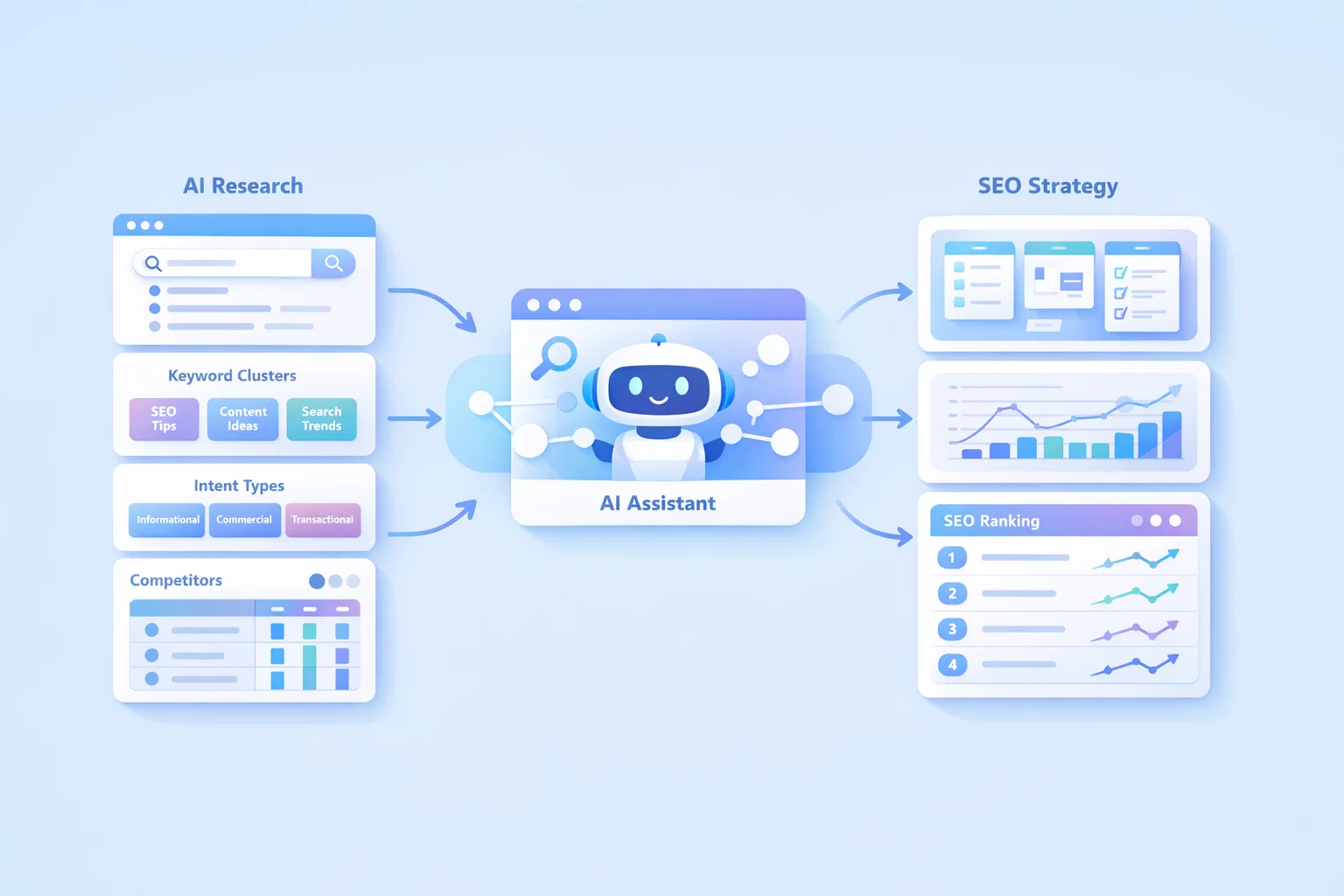
Search behavior is changing fast. More users now get quick answers directly on result pages, compare fewer links, and move between classic search, AI summaries, forums, and chat interfaces in one session. That shift makes research more demanding. You are no longer building pages only for one blue-link ranking model. You are building assets that need to be clear, useful, and easy for both people and AI systems to interpret.
What Is AI Keyword Research
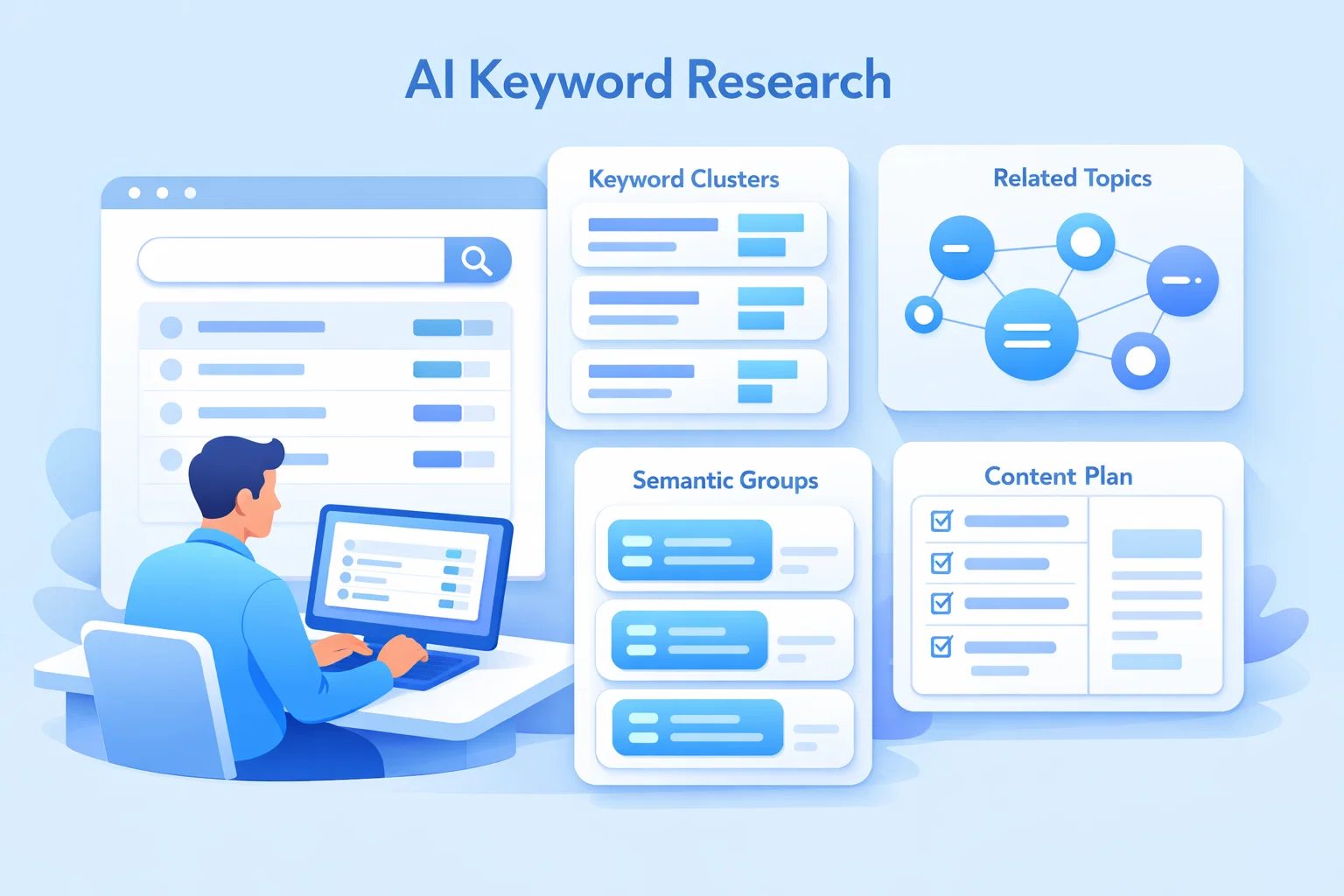
AI keyword research is a process that uses models, search data, and language analysis to identify keywords, group keywords and phrases, and turn them into a workable content plan. Instead of building a list of keywords one row at a time, you can use ai tools like language models and keyword research tools to get a list of related ideas, related terms, and related keyword ideas much faster.
AI keyword research definition
In simple terms, this is in-depth keyword research supported by systems that can analyze the keyword landscape, expand seed topics, and connect semantically related phrases. It often starts with broad ideas, then moves into specific keywords, multiple keywords in one topic group, and finally a list of keywords to target by page type.
Difference between AI-driven and traditional keyword research
Traditional methods often depend on spreadsheets, exports, and manual research. That approach still works, but it becomes slow when you need to review thousands of keywords across several products or audience segments.
AI-driven research changes the pace. Ai tools can analyze large sets of keywords and phrases, group them by intent, and suggest which terms belong together. The result is not just speed. It is a clearer structure for seo content, better guide targeting, and faster movement from research to execution.
Role of NLP in keyword discovery
Natural language processing helps systems read meaning rather than only exact wording. That matters because users often search with related terms, long phrases, or conversational questions instead of one perfect search query.
NLP is especially useful when you want to identify keywords related to a topic but phrased in very different ways. It helps uncover search patterns, list of related expressions, and the context behind a search that may not be obvious from a short export.
Place of AI keyword research in modern SEO
Modern optimization is no longer about one page for one phrase. A useful seo strategy connects search intent, page structure, topic coverage, and internal linking. AI keyword research supports that larger system by helping teams optimize titles, subheads, FAQs, and support pages around real search behavior.
A practical role for AI research in modern planning includes:
- expanding seed topics into strategic keyword clusters
- finding keywords based on audience pain points
- surfacing related questions from search results
- helping seo experts reduce overlap between pages
- improving seo and content marketing alignment
Why AI Keyword Research Matters for SEO and AI Search
As AI search results become more visible, businesses need better ways to do keyword research. Ranking for a term still matters, but it is no longer enough on its own. You also need pages that help AI systems interpret your expertise, surface relevant answers, and connect your content with broader search journeys, especially as recent guidance on emerging search features shows.
Speed and efficiency for large keyword sets
When a site covers several product lines or service categories, the raw volume of candidate terms can grow fast. Ai-powered tools help teams sort large sets, get a list of related ideas, and move from scattered notes to structured clusters in less time.
This is useful because the real bottleneck is rarely idea generation. The bottleneck is deciding which opportunities deserve production time and which should stay in research.
Smarter keyword clustering
Smarter clustering is one of the strongest reasons to use ai tools like ChatGPT alongside dedicated seo tools. Good clustering groups keywords and phrases around one search intent and one page goal.
A strong cluster often includes:
- one central term
- several close variants
- related keyword ideas
- supporting questions
- comparison or alternative phrasing
That helps you avoid thin pages and improves how you optimize site architecture.
Intent detection at scale
Intent detection matters because many specific keywords look similar on the surface while serving very different needs. One term may signal learning intent, another comparison intent, and another buying intent.
AI can analyze wording patterns at scale and suggest likely intent groups. That helps marketers reduce guesswork before they review search engine results manually.
Real-time competitor insights
Competitor research becomes easier when AI helps summarize recurring themes, missing subtopics, and weak points in rival pages. This is useful for seo strategy because it shows where the market is already crowded and where a better angle may still win.
A practical competitor review often checks:
- page type and page depth
- title angle
- questions answered
- evidence and proof
- freshness of information
Predictive trend forecasting
Some opportunities rise quickly because of product launches, market shifts, or seasonal demand. AI can also help identify patterns that suggest a topic is gaining traction before it becomes obvious in every database.
That gives you more time to build pages that answer new questions before the result page becomes highly competitive.
Better content planning across funnel stages
A strong plan should not focus only on top-of-funnel traffic. It should support awareness, evaluation, decision, and post-purchase needs. AI research makes it easier to build that full map.
This helps teams connect seo and content into one system instead of producing isolated assets that do not support each other.
How AI Transforms Traditional Keyword Research
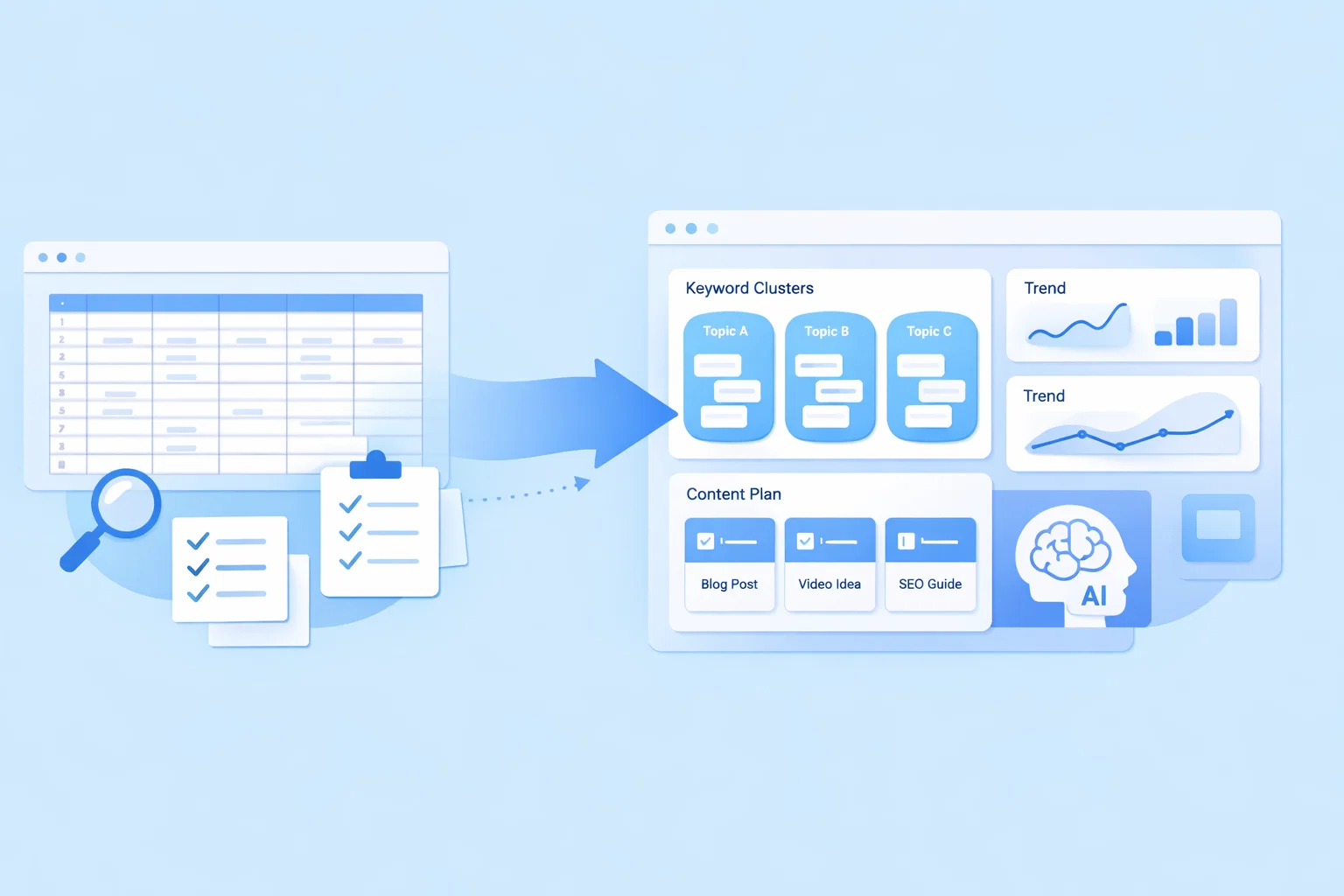
The biggest shift is not that AI removes research. The shift is that it changes how research is organized. Traditional workflows move slowly from export to spreadsheet to page plan. AI speeds up expansion, comparison, and early clustering so more time can go into judgment and refinement, especially as performance reporting documentation shows how search visibility and engagement metrics need to be read together.
That matters because weak results often come from weak planning, not weak writing. If the topic is too broad, the intent is mixed, or the list of keywords is poorly grouped, even strong writing will struggle.
From manual keyword lists to automated expansion
Manual research often starts with obvious category terms. That can leave out the language buyers use in real search results. AI helps expand from those initial phrases into keywords related to pain points, outcomes, alternatives, and industry-specific variations.
This wider field is valuable because a page usually ranks for multiple keywords, not just one target phrase.
From isolated terms to topic clusters
Topic clustering is more useful than isolated targeting because it produces richer pages. When you group semantically related ideas together, you can build one page that serves the broader need behind a search rather than forcing separate thin pages for every minor wording difference.
This usually improves:
- topical depth
- internal linking logic
- heading quality
- support for related questions
- visibility across multiple keywords
From static metrics to live market signals
A static export can only show so much. Live performance data tells you what is actually moving, which terms are starting to appear, and where rankings improve without matching click growth. Google Search Console is especially useful here because it helps connect page performance with real search query behavior.
That is important for seo because ranking movement, CTR changes, and impression growth often reveal where to expand or refine.
From guesswork to data-backed prioritization
Many teams waste time chasing keywords with high volume but weak business value. Data-backed prioritization fixes that by comparing demand, competition, business relevance, and click potential at the same time.
A practical model may include:
| Factor | What to review | Why it matters |
| Demand | Search volume and trend direction | Shows topic size |
| Competition | Strength of current winners | Sets ranking reality |
| Intent fit | Match between term and page type | Reduces wasted effort |
| Business value | Revenue or pipeline link | Keeps work useful |
| Click potential | Traffic likelihood from visibility | Improves forecasting |
From keyword research to content workflows
Once research is structured well, it can support much more than topic selection. It can shape outlines, internal links, FAQ sections, visuals, and content refresh priorities.
That is where AI becomes highly practical. It helps turn research into a system for seo and content marketing rather than a one-time document.
Benefits of Using AI for Keyword Research
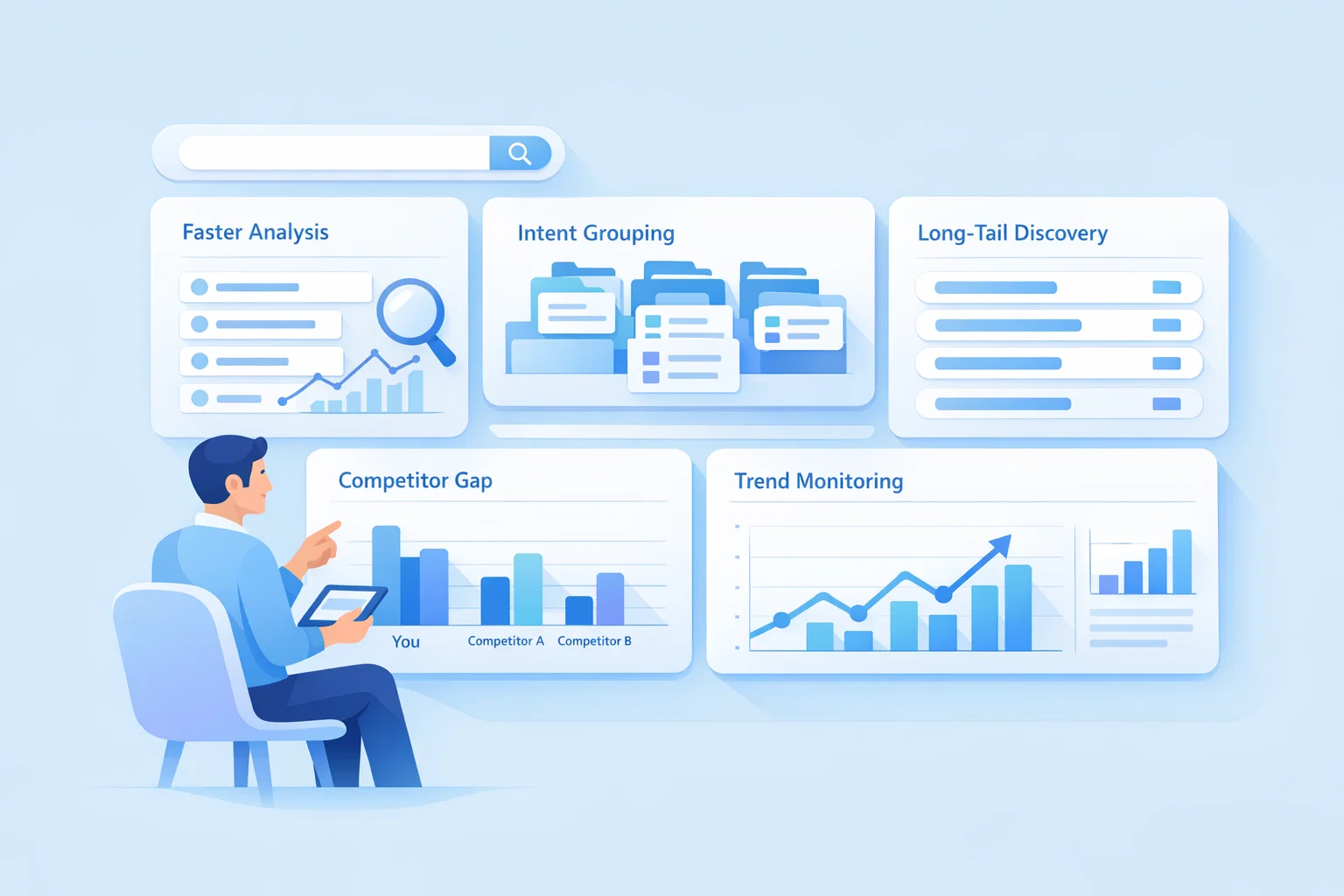
The value of AI is usually practical rather than dramatic. It helps you move faster, sort broader datasets, and uncover angles that are easy to miss in a purely manual process. For teams handling large content programs, that can make a meaningful difference.
Faster data collection and analysis
A modern workflow may pull from ranking tools, CRM notes, search data, support conversations, forums, and competitor pages. AI can analyze and summarize those sources faster than a manual method alone.
That does not remove review. It simply makes the first pass stronger and much easier to manage.
More accurate search intent analysis
Intent improves when you combine AI labels with live result-page checks. The model may suggest what a phrase means, but the result page shows how the search engine interprets it.
That extra step is important for seo because it prevents teams from building the wrong asset for the wrong need.
Long-tail keyword discovery with conversion potential
Long-tail phrases often reveal more about the person searching. They may show urgency, team size, technical need, or commercial readiness. Those clues help you choose target keywords that are easier to convert.
This is one reason AI can help smaller sites. It often surfaces lower-volume phrases with stronger intent and clearer relevance.
Content optimization based on keyword patterns
Once you see repeated language in a cluster, you can improve page structure more confidently. You can add missing explanations, refine subheads, and strengthen examples without obsessing over keyword density.
Useful optimization signals often include:
- repeated objections
- recurring comparisons
- implementation steps
- common feature mentions
- related questions from communities
Competitor keyword gap discovery
Gap analysis is stronger when it looks beyond missing terms and asks why competing pages work. Are they more specific, more complete, or more closely aligned with the intent behind a search?
That perspective helps teams improve page quality instead of just growing a longer list of keywords.
Trend monitoring over time
Search behavior changes over time, and so do the terms people use. Trend monitoring helps you spot when a cluster is rising, flattening, or splitting into narrower subtopics.
That makes refresh decisions more strategic and keeps your seo strategy aligned with real demand.
Using AI-Powered Keyword Tools
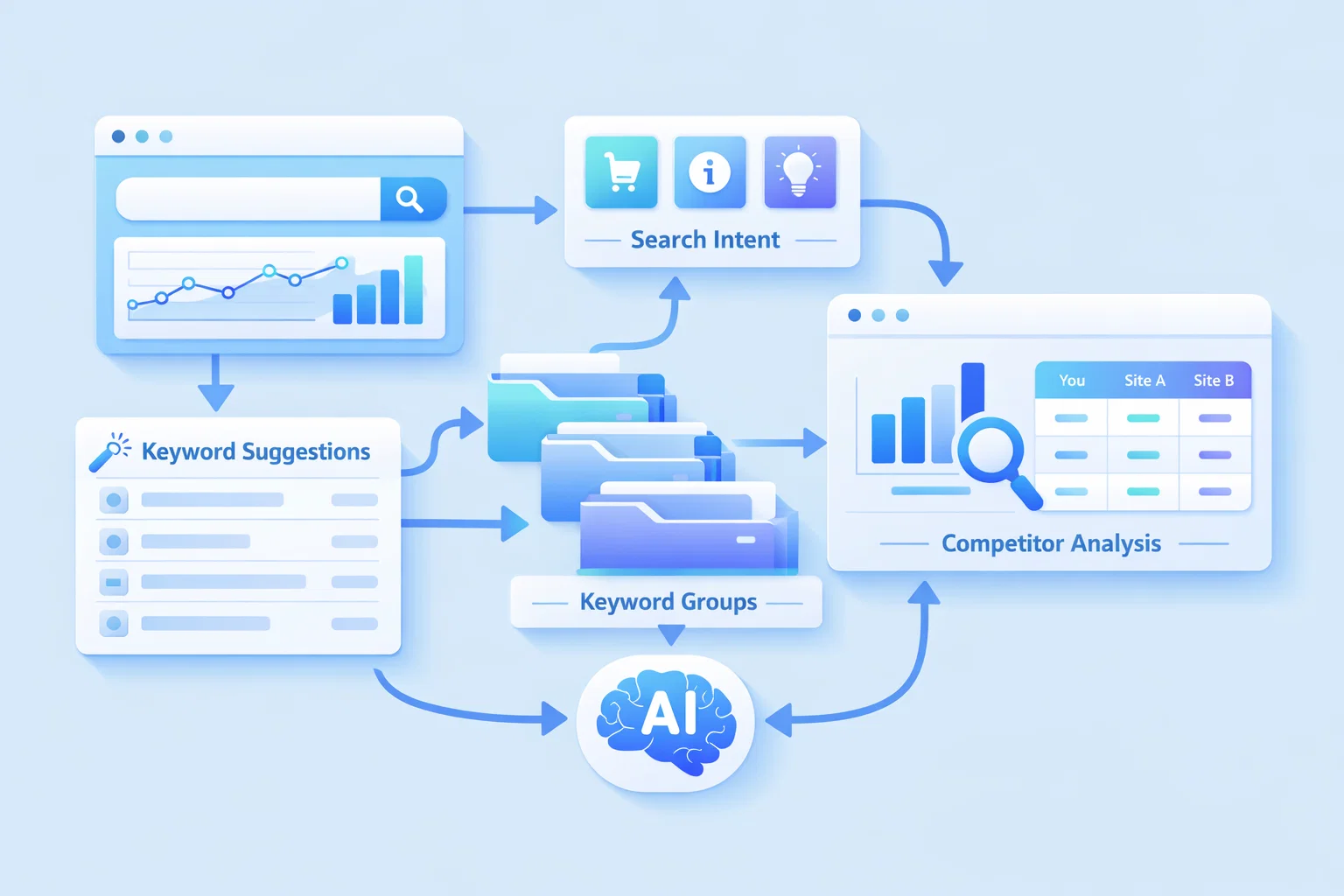
No single platform does everything well. The best stacks usually combine tools like general language models, database-driven keyword research tools, and analytics platforms. Each one supports a different part of the process.
Keyword generation from seed topics
Start with one clear seed topic, then expand by audience role, use case, problem, feature, and outcome. This helps you get a list that is broader than your internal product language.
NLP-based intent classification
Intent classification is useful because it helps teams sort terms before they build pages. AI tools use language patterns to separate informational, commercial, and transactional phrasing.
Automatic grouping and keyword organization
Grouping is one of the most valuable features in modern tools for seo. When a system can organize related terms into useful clusters, it becomes easier to map one page to one need.
A quick grouping checklist:
- Does one page type fit the cluster
- Do the terms share the same intent
- Can one page answer them naturally
- Are there enough related terms to support depth
- Is there already a competing page on the site
Competitor analysis for keyword opportunities
Some tools available focus more on broad databases, while others help with page-level comparisons. The best use of either is to compare topic depth, ranking angles, and missing subtopics.
SERP feature and search suggestion analysis
Search engine results often include related searches, People Also Ask, and AI summaries that reveal what users need next. These elements are especially useful for finding related questions and shaping FAQ sections.
Performance tracking and workflow integration
Once pages go live, research should connect to measurement. Google Search Console, ranking reports, and page-level reviews help you see whether your target keywords are gaining impressions, clicks, and stronger positions.
Best AI Tools for AI Keyword Research
The best choice depends on what you need most. Some teams need deeper databases. Others need better clustering, briefing, or support for content strategies.
ChatGPT for keyword ideation and clustering
Tools like ChatGPT are useful for first-pass ideation, clustering, and turning a rough concept into a structured content plan. They work best when you provide audience language, page goals, and clear constraints.
They are less dependable as a standalone source of search demand, so they should support research rather than replace live validation.
Semrush for keyword databases and gap analysis
Semrush is widely used for large-scale discovery, competitor comparisons, and broad topic exploration. It is helpful when you need many keywords to target across several categories.
Its Keyword Magic Tool is often used for expansion because it helps teams sort large datasets, filter by intent, and organize related terms quickly.
Ahrefs for competition and ranking insights
Ahrefs is often strong when you need page-level competition insight, ranking visibility, and backlink context. It is useful for deciding whether a topic is realistic for your current authority level.
Surfer SEO for content optimization signals
Surfer is more useful later in the workflow, when you want to connect keyword research with writing and page improvement. It can support seo content planning by showing gaps in coverage and likely support terms.
Moz Keyword Explorer for keyword evaluation
Moz can be practical for lighter workflows that still need useful scoring and topic evaluation. It is often chosen by teams that want simpler reporting without adding too many systems.
Google Keyword Planner for baseline demand data
Keyword Planner is useful for baseline demand checks and commercial phrasing. It can be a valuable source when paired with organic review and broader seo tools.
SE Ranking and other AI keyword tools
SE Ranking and similar platforms can suit teams that want several functions in one place. Many ai seo tool like these try to combine clustering, monitoring, and planning in one dashboard.
How to Use AI for Keyword Research
A strong process should be repeatable, easy to audit, and flexible enough to work across several topic areas. The goal is not complexity. The goal is clarity.
Step 1: Define topic, goals, and seed keywords
Start with the business goal, the audience problem, and the page type you need. Then choose a few seed terms that describe the topic clearly enough to expand from.
Step 2: Generate keyword ideas with AI tools
Use ai tools like ChatGPT and other tools like dedicated databases to expand from those seeds. Ask for use-case terms, alternative phrasing, comparison terms, and audience-specific wording.
Step 3: Search for related keywords and variations
This stage focuses on related terms, objections, alternatives, and support phrases. It helps you turn broad topics into more precise opportunities.
Step 4: Analyze keyword metrics
At this point, review volume, competition, click potential, and business fit. The goal is not only to analyze the keyword in isolation, but to see whether it fits a useful page plan.
Step 5: Break down keywords by user intent
Sort phrases by learning, comparing, buying, and solving intent. This makes it much easier to match each cluster to the right type of page.
Step 6: Group keywords into topic clusters
Cluster terms around one clear page promise. Do not force unrelated keywords into one page just because they share a main noun.
Step 7: Discover competitor keywords and content gaps
Review rival pages and compare their depth, trust signals, examples, and structure. This often reveals subtopics you still need to cover.
Step 8: Prioritize keywords by value and difficulty
Choose keywords with high business relevance first, not just keywords with high volume. A smaller phrase may still be a better commercial opportunity.
Step 9: Track keywords and monitor performance
Once the page is live, review how it performs in search engine results and whether the cluster is attracting the right traffic. This is where you decide whether to refresh, expand, or split the page.
How to Find Keywords with AI
Strong discovery is built from several inputs at once. You need tools to identify demand, but you also need customer language, competitor context, and result-page review.
Check existing search rankings
Start with terms that already show impressions. They are often the fastest opportunities because the page already has some visibility and may only need better alignment to win more clicks.
Use first-party data from sales and support teams
Sales calls, onboarding notes, support tickets, and customer emails often reveal better keywords than broad databases do. They show how real buyers describe problems in their own words.
Mine forums, communities, and social platforms
Forums help uncover the language people use when they are confused, comparing options, or trying to solve a problem. That is useful for finding keywords related to genuine user needs.
A useful workflow here:
- collect repeated questions
- pull wording that reflects pain points
- group by problem type
- compare with search results
- turn strong patterns into page ideas
Search keyword databases for scale
Keyword databases help when you need thousands of keywords, regional comparisons, or fast filtering by intent and topic group. They are strongest when the topic map is already clear.
Conduct keyword gap analysis
Gap analysis helps you see missing terms, weak coverage, and pages that are not deep enough. It is also useful for choosing which strategic keyword groups deserve dedicated assets.
Analyze related searches, People Also Ask, and AI Overviews
These features help reveal follow-up questions, support terms, and the likely expectations behind a search. They are useful for structuring intros, FAQ sections, and support content.
How to Prioritize AI-Generated Keywords
Expansion is easy. Prioritization is where real strategy begins. The goal is to choose keywords based on realistic ranking potential, page fit, and business value.
Assess search volume
Search volume helps estimate demand, but it should not decide everything. Broad terms may look attractive while offering weak conversion potential.
Evaluate ranking difficulty
Difficulty scores help, but they need context. Always look at who ranks, what page type wins, and how strong the current field really is.
Determine conversion potential
Some keywords with high volume are poor choices because they attract casual readers rather than qualified prospects. A lower-volume term can be more valuable if it signals strong intent.
Measure click potential
Click potential matters because visibility and traffic are not the same thing. Some search results now satisfy users before they click, so page opportunity needs to be judged more carefully.
Spot real-world demand signals
Demand is not only visible in keyword tools. It also appears in sales questions, demos, support themes, and product adoption patterns.
Review search trends and seasonality
Some opportunities rise and fall quickly. Trend review helps you avoid publishing too late or investing too heavily in fading topics.
Keyword Research Metrics That Matter
A useful metric set should connect demand, performance, and business outcomes. Rankings alone are not enough.
Search volume
This shows estimated demand and helps compare broad opportunities.
Keyword difficulty
This gives a directional view of competition, though it should never replace manual review.
Search intent
Intent should guide page type, CTA style, and how deeply a topic is explained.
Traffic potential
Pages rank for clusters, not only one term, so traffic potential is often more useful than one single keyword score.
Trend data
Trend data helps you judge timing, especially in seasonal or fast-changing industries.
Business relevance
This is the strongest filter because it keeps the roadmap tied to real outcomes.
A practical metric stack includes:
| Metric | Primary use |
| Impressions | Visibility trend |
| Clicks | Traffic generation |
| CTR | Snippet and title fit |
| Position | Ranking movement |
| Conversions | Commercial value |
| Trend direction | Timing and refresh planning |
Monitoring Keyword Trends with Predictive SEO
Predictive work is about spotting meaningful movement early. It helps teams decide where to publish first, where to refresh, and which keywords to target before the space becomes crowded.
Forecast rising keyword topics
Look for new modifiers, repeated questions, and shifts in audience language across several channels.
Identify seasonal opportunities early
Seasonal planning works best when pages are ready before demand peaks, not after the result page fills up.
Watch competitor movement over time
New landing pages, updated comparisons, and fresh category pages often reveal where competitors see growth.
Refresh content based on trend changes
A useful refresh improves examples, updates information, and adds missing depth rather than only changing a date.
Combine predictive insights with ranking data
Prediction is strongest when paired with actual performance. Trend signals help you move early, while performance data tells you whether the move worked.
Challenges and Limitations of AI in Keyword Research
AI is useful, but it also creates risks if used without review. The biggest one is false confidence. Clean output can still be shallow, inaccurate, or disconnected from real search behavior.
Inaccurate or incomplete keyword suggestions
Models may invent awkward phrases or miss highly specific keywords that matter to your audience.
Overreliance on tool-generated data
A polished export can create the illusion of rigor. Without validation, even strong-looking data may lead to weak decisions.
Missing search context behind queries
Some terms look valuable until you inspect the result page and see mixed intent, dominant brands, or formats your site cannot match.
Need for manual validation and SERP review
Manual review remains essential because it shows page type, trust signals, and the actual context behind a search.
Risk of generic clustering and content sameness
When too many teams use the same prompts, the content starts to look alike. That weakens originality and makes it harder to stand out.
Limits of AI without first-party data
Without support logs, sales insight, and customer language, recommendations often stay generic. First-party signals add the nuance that generic tools available cannot always provide.
Common warning signs include:
- clusters with mixed intent
- pages competing with each other
- weak alignment between topic and offer
- strong impressions but weak clicks
- briefs that feel generic before writing starts
Frequently Asked Questions
Not fully. Tools like large language models are strong for ideation and clustering, while platforms such as Ahrefs and Semrush remain more dependable for competition review, database depth, and long-term tracking. Most teams get better outcomes when they combine both.
That depends on your workflow. Tools like ChatGPT are useful for first-pass grouping, while dedicated seo tools are stronger when you need clustering tied to rankings, page maps, and reporting.
Review the live search results, compare them with first-party customer language, and check whether the intended page can satisfy the query naturally. If the phrase does not match the actual intent on the result page, it should not move forward.
Yes, especially when it helps uncover keywords based on narrow needs, role-specific phrasing, and long-tail problems. Still, lower competition does not remove the need for strong page quality and clear relevance.
Use those sources to find the language real people use when describing problems, failed attempts, and comparison criteria. Then validate those patterns against live search data and actual search engine results before building a page around them.
The most common mistakes are skipping validation, relying too much on automation, chasing volume over value, and trying to optimize for every variation instead of building one strong page around a clear need.