

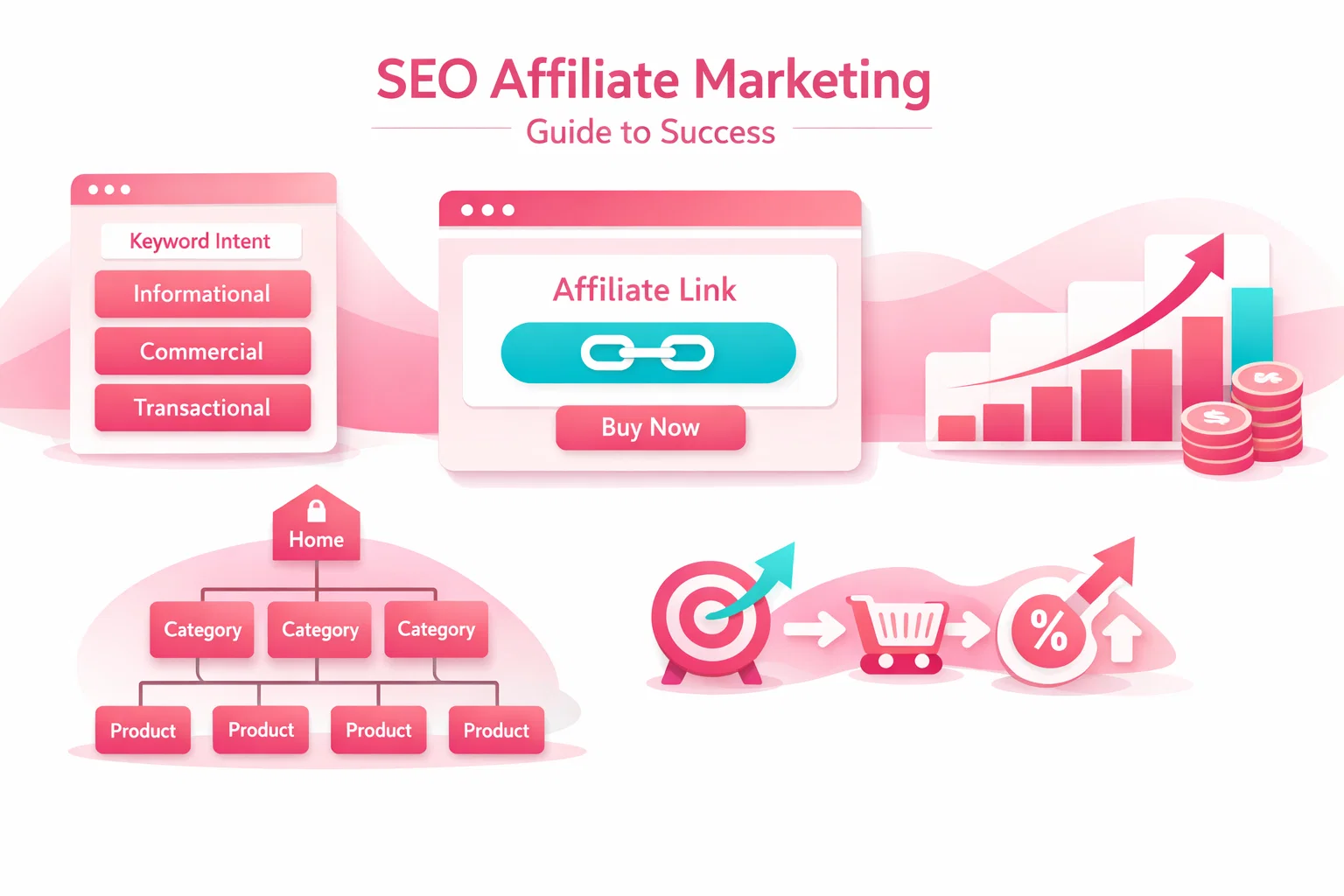
Affiliate SEO marketing sits at the crossroads of two powerful disciplines: earning commissions by promoting products and optimizing web content to rank in search engines. When done well, this combination creates a self-sustaining traffic engine that generates revenue around the clock. This guide to SEO and affiliate marketing walks you through everything you need to build and scale a site that earns consistently.
Definition and Importance for the Modern Affiliate Marketer
At its core, affiliate SEO is the practice of using search optimization to drive targeted visitors to pages that contain affiliate links. Rather than paying for each click, you invest in content and technical improvements that earn organic placement on search engine result pages.
The importance of this approach has grown significantly within digital marketing. With advertising costs rising year over year, organic search represents one of the few scalable channels where your cost per visitor actually decreases over time as your authority builds.
How Affiliate Marketing and SEO Work Together
SEO is the process of making your content visible to people actively searching for solutions. Affiliate marketing then monetizes that attention by connecting readers with relevant products or services in exchange for a commission. Blending SEO and affiliate marketing effectively means every piece of content serves two masters: the search algorithm and the human reader.
A well-structured review article can rank for hundreds of long-tail queries simultaneously, each representing a potential buyer. The content earns its placement through relevance and authority, not ad spend.
Affiliate SEO vs. Client SEO Comparison
Understanding the distinction helps you apply the right mindset and marketing strategies:
| Dimension | Affiliate SEO | Client SEO |
| Goal | Drive affiliate revenue directly | Improve a client’s business metrics |
| Ownership | You own the site and monetization | Client owns the business |
| Content focus | Reviews, comparisons, buyer guides | Service pages, local content, brand |
| Risk tolerance | Higher, more experimental | Conservative, brand-safe |
| Monetization timeline | Delayed but compounding | Ongoing retainer or project fees |
| Link building | Often harder without brand authority | Leverages existing brand relationships |
Three Pillars of Search Optimization for Your Affiliate Website
Every strong affiliate site rests on three foundations that cover the core aspects of SEO:
- Technical SEO — ensuring search engines can crawl, index, and understand your site
- On-page optimization — creating content that matches search intent and satisfies user needs
- Authority building — earning links and signals that demonstrate trustworthiness to Google
Why SEO Strategies are Crucial for Affiliate Marketing
Many beginners assume that publishing product comparisons is enough. In reality, without a coherent set of SEO and affiliate marketing strategies, even excellent content can remain invisible. SEO helps bridge the gap between great writing and actual traffic, making it the foundation of any serious affiliate operation.
Sustainable Organic Traffic vs. Paid Ads
Paid advertising delivers immediate results but stops the moment your budget runs out. Organic traffic compounds. A page that ranks in position one for a commercial keyword can generate consistent clicks for years with minimal ongoing investment.
Data from Ahrefs consistently shows that the top organic result receives roughly 27% of all clicks for a given query. That kind of sustained visibility is nearly impossible to replicate with paid channels at a comparable cost. Seo focuses on building this kind of durable, compounding asset — something no marketing campaign budget alone can buy.
Long-term ROI and Scaling Your Affiliate Site
The economics of SEO favor patience. Investing in SEO yields little in month one. By month twelve, however, a well-executed site can generate returns that far exceed what the same budget would produce in paid acquisition.
Scaling becomes easier too. Once you understand which content types and keyword categories convert, you can replicate that formula systematically across additional topics or even new niches.
Impact on Conversions and Affiliate Network Revenue
Organic visitors tend to convert at higher rates than paid traffic for most affiliate categories. This is partly because someone who finds your review through a search query has self-selected — they are already researching a purchase decision.
Higher conversion rates mean more revenue per thousand visitors, which improves the economics of every piece of content you publish. The effectiveness of your SEO efforts is ultimately measured here: not just rankings, but revenue generated per organic session.
Survival of Well-Optimized Sites During Google Updates
Google’s core updates frequently penalize thin, low-value sites while rewarding those that demonstrate genuine expertise and user value. Sites that have invested in E-E-A-T signals, comprehensive content, and clean technical foundations tend to recover faster or avoid volatility entirely.
Benefits and Drawbacks of SEO Efforts
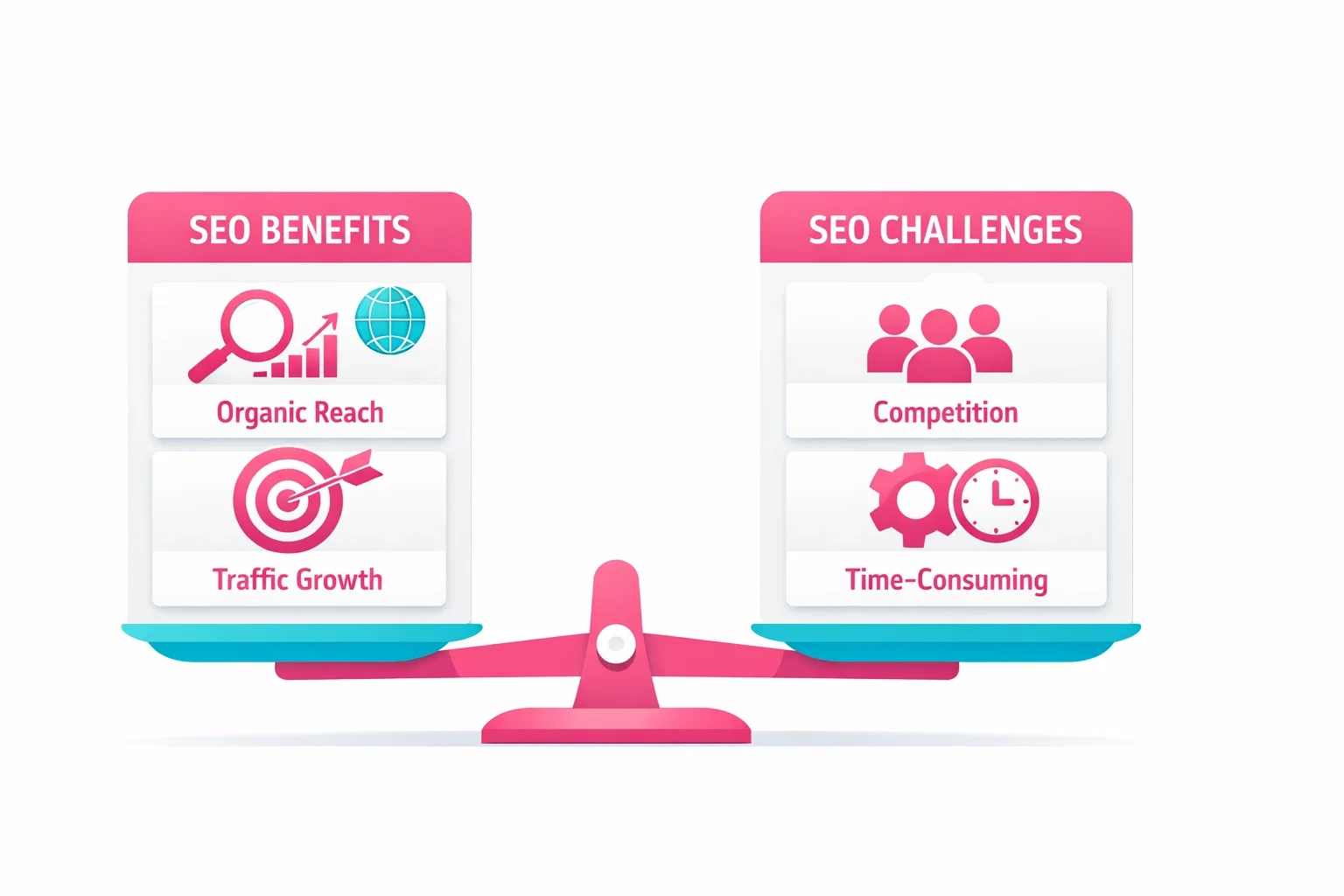
No channel is without tradeoffs. Understanding both sides helps you set realistic expectations and make better investment decisions.
Pros of Organic Growth for Niche and Affiliate Programs
- Compounding traffic returns over time
- Lower cost per visitor compared to paid channels
- Higher buyer intent among organic searchers
- Greater trust from users who find you naturally
- Ability to build a genuine media asset with real valuation
Common Challenges and High Competition in the Sector
Affiliate marketing in popular verticals — finance, health, software, and travel — is fiercely competitive. Established publishers with years of domain authority and thousands of backlinks dominate many high-value keywords.
Newcomers often underestimate how long it takes to break through. Most SEO professionals and seo services providers suggest allowing six to twelve months before expecting meaningful organic traffic from a new domain.
Balancing Affiliate Links and User Experience
One of the more nuanced challenges is knowing when links help versus hurt the experience. Too many links signal commercial intent over helpfulness, which can erode reader trust and send negative signals to search algorithms.
The general principle: links should serve the reader’s journey, not interrupt it. Every placement should feel like a natural next step, not a forced insertion.
E-E-A-T Signals and Value Creation
Google’s Search Quality Evaluator Guidelines place enormous weight on Experience, Expertise, Authoritativeness, and Trustworthiness. For affiliate sites, this means:
- Clear author attribution with verifiable credentials
- Original research, testing, or first-hand product experience
- Transparent disclosure of affiliate relationships
- Consistent, accurate information across all content
Sites that treat E-E-A-T as a checklist rather than a genuine commitment tend to underperform during quality-focused algorithm updates.
How to Do SEO for Affiliate Marketing Step-by-Step
Building a successful affiliate site requires deliberate sequencing. Shortcuts at the foundation stage create problems that compound over time. Use this section as your practical seo guide for getting the fundamentals right from day one.
Choose a Profitable Niche and Affiliate Programs
Niche selection determines your ceiling. The ideal niche combines:
- Sufficient search volume to justify the investment
- Commercial products with reasonable commission structures
- Manageable competition for a new entrant
- Your genuine interest or expertise, which improves content quality
Research programs in your target niche before committing. Commission rates, cookie durations, and conversion support vary enormously between programs.
Select a Good Domain Name and Web Hosting
Your domain name should be brandable, memorable, and broadly relevant to your niche without being so narrow that it limits future expansion. Avoid exact-match domains that look spammy.
Hosting quality directly affects both user experience and technical SEO. Invest in a reliable provider with strong uptime guarantees and server locations close to your primary audience.
Perform Comprehensive Keyword Research for Affiliate Sites
Affiliate keyword research is the backbone of any content strategy. The goal is to identify queries where:
- Users have buying intent or strong interest
- Competition is beatable given your current authority
- The products you promote are directly relevant
Use tools like Google Keyword Planner, Ahrefs, Semrush, and Google Search Console. Each contributes different insights, and combining them produces a more complete picture than relying on any single source.
Identify Search Intents: Transactional vs. Informational
Search intent falls into four categories, but for affiliate sites, two matter most:
- Transactional intent: The user is ready to buy or close to it. Queries like “best noise-cancelling headphones under 200” signal high purchase readiness.
- Informational intent: The user is researching. Queries like “how does noise cancellation work” offer opportunities to build authority and introduce products contextually.
A healthy site serves both, using informational content to build topical authority that indirectly supports transactional pages.
Focus on Long-Tail Keywords with Buyer Intent
Long-tail keywords — typically three or more words — convert better and face less competition than short head terms. A query like “best project management software for freelancers” is far more actionable than simply “project management software.”
These phrases also capture specific use cases, which allows you to write genuinely useful content rather than generic overviews.
Prepare a Solid Affiliate Content Strategy
Your content strategy should map out:
- Core money pages: comparison articles, best-of lists, detailed reviews
- Supporting content: tutorials, explainers, problem-solving articles
- Internal linking architecture: how supporting pages funnel authority to money pages
Consistency matters as much as quality. A publishing schedule you can maintain is better than an ambitious one you abandon.
On-Page SEO Best Practices for Affiliate Content
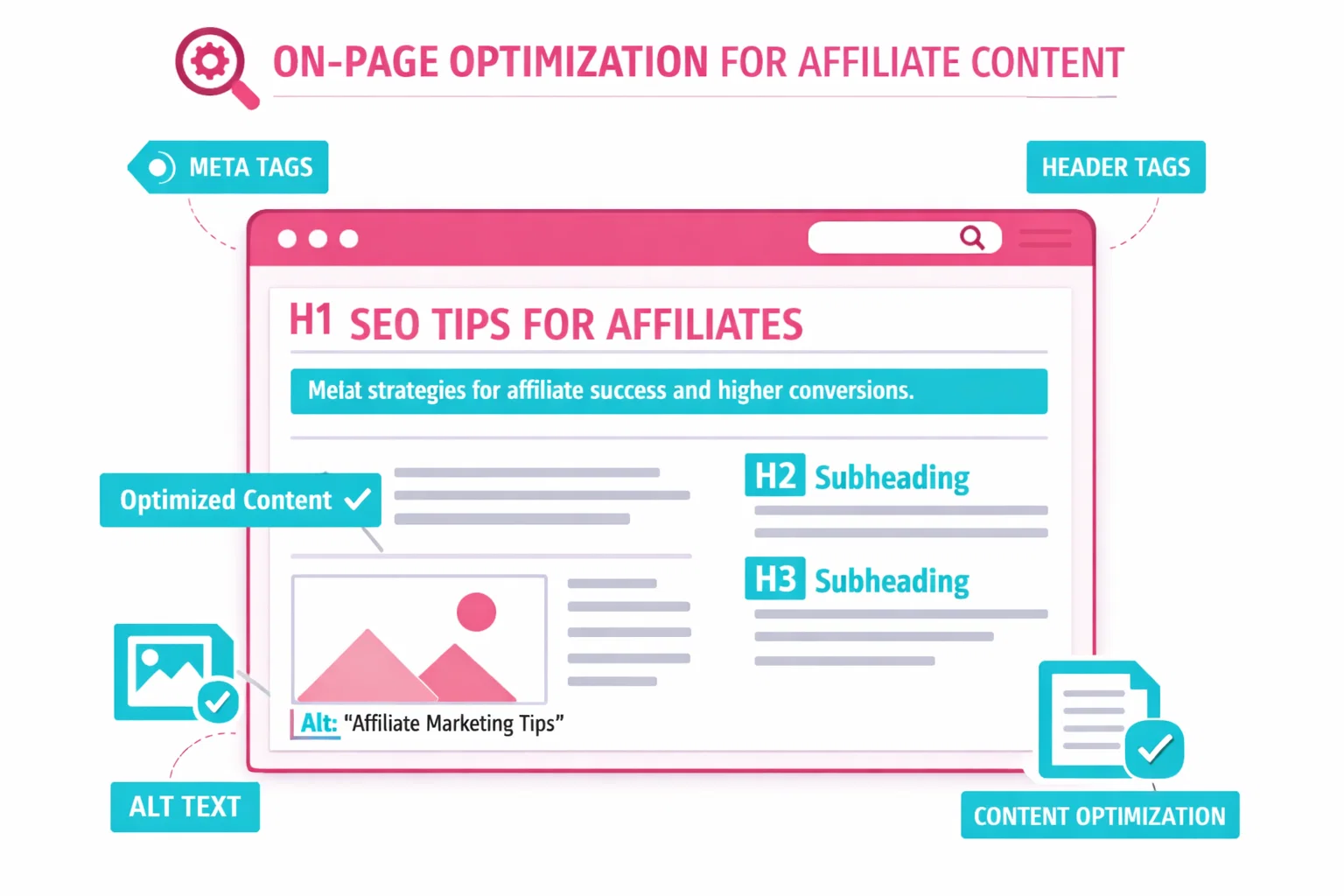
Once your strategy is set, execution at the page level determines whether your content ranks and converts. Applying strong on-page SEO techniques consistently across your site is one of the highest-leverage activities available to independent publishers.
Create High-Quality, Link-Worthy Assets
The most effective content does more than summarize product features. It provides original value: hands-on testing results, direct comparisons, unique data, or expert commentary that readers cannot find elsewhere.
Content worth linking to earns backlinks organically, which reduces your dependence on active outreach.
Optimize Titles, Meta Descriptions, and URLs
- Titles should include the primary keyword near the beginning and communicate clear value
- Meta descriptions should summarize the page’s benefit in under 160 characters
- URLs should be short, descriptive, and free of unnecessary parameters
Each of these elements affects click-through rates from search results, which in turn influences ranking signals.
Content Formatting for Readability and Engagement
Wall-of-text content loses readers quickly. Formatting practices that improve engagement include:
- Short paragraphs of two to four sentences
- Subheadings that allow skimming
- Bullet points for feature lists or comparisons
- Bold text for key terms, not for decoration
- Images or tables where visual presentation clarifies information
Optimizing your affiliate content for readability is just as important as optimizing it for search engines like Google. A page that ranks but doesn’t hold attention will not convert.
Use Structured Data and Schema Markup
Schema markup helps search engines understand your content’s structure and can generate rich snippets in search results. For affiliate content, relevant schema types include Review, Product, and FAQ markup.
Rich results increase click-through rates without requiring any change in ranking position — a meaningful advantage in competitive verticals.
Optimize for Mobile and Voice Search
Over half of all search queries now originate on mobile devices. A site that performs poorly on mobile loses both rankings and conversions. Voice search, growing steadily through smart speakers and mobile assistants, favors conversational, question-answering content.
Both trends reward the same approach: clear, concise, well-structured content that answers questions directly.
Strategic Internal Linking Structure
Internal links distribute authority across your site and guide users toward conversion pages. Every informational article should link to at least one relevant money page. Review pages should link to related comparisons or alternatives.
A deliberate internal linking strategy can meaningfully improve rankings for commercial pages without any additional backlink acquisition.
Technical SEO Strategies for Affiliate Success
Technical issues are silent killers for affiliate sites. They often go unnoticed until traffic drops sharply. For SEO for affiliate marketers, the technical layer is as important as content — and far more often neglected.
Site Speed and Performance Monitoring
Page speed is both a direct ranking factor and a conversion factor. Research from Google indicates that as page load time increases from one to five seconds, the probability of a mobile user bouncing increases by 90%.
Regular audits using Google PageSpeed Insights identify opportunities to compress images, eliminate render-blocking scripts, and leverage browser caching.
Crawlability and Indexing Best Practices
Search engines must be able to discover and index your pages efficiently. Common issues that block this include:
- Misconfigured robots.txt files
- Orphaned pages with no internal links
- Duplicate content from URL parameters
- Noindex tags applied incorrectly
A regular crawl audit using tools like Screaming Frog or Sitebulb surfaces these problems before they cause lasting ranking damage.
Site History and Brand Safety for Domains
If you purchase an aged domain, investigate its history thoroughly. Domains previously used for spam, link schemes, or low-quality content carry penalties that are difficult to overcome. Use the Wayback Machine and tools like Ahrefs’ Site Explorer to verify domain history before investing.
Core Web Vitals for Affiliate Landing Pages
Google’s Core Web Vitals measure three dimensions of page experience:
- Largest Contentful Paint (LCP): how quickly the main content loads
- Interaction to Next Paint (INP): how responsive the page feels to user interaction
- Cumulative Layout Shift (CLS): how stable the layout is as it loads
Landing pages with heavy ad scripts, multiple banners, and unoptimized images frequently struggle with all three. Prioritizing these metrics pays dividends in both rankings and user experience.
Off-Page SEO and Link Building Strategies for Affiliate Sites
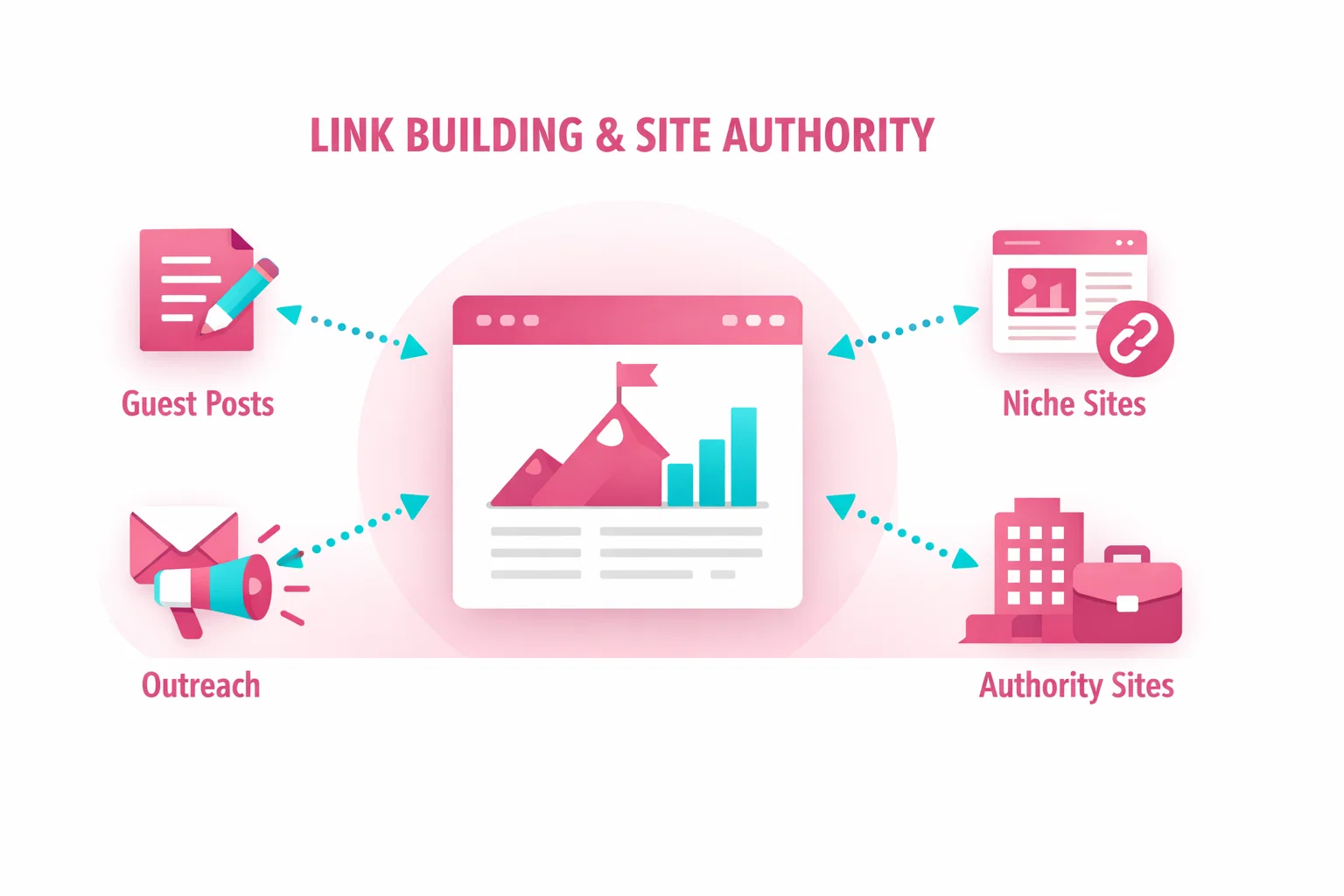
Backlinks remain one of the most significant ranking factors in Google’s algorithm. Building them ethically and strategically is non-negotiable for competitive niches.
Build High-Quality Backlinks via Outreach
Outreach-based link building involves identifying relevant websites and presenting a compelling reason for them to link to your content. The most effective pitches offer genuine value — a data resource, a unique tool, or content that fills a gap on their site.
Mass outreach with generic templates yields diminishing returns and risks association with manipulative link schemes.
Advanced Guest Posting on Relevant Sites
Guest posting on authoritative sites in your niche builds both links and brand awareness. The key is selectivity — target publications with real audiences and genuine editorial standards, not link farms masquerading as blogs.
Quality guest posts should provide real value to the host site’s readership, not exist solely as a vehicle for your link.
Monitor Online Reputation and Authority
Your site’s reputation extends beyond search rankings. Mentions in forums, social media conversations, and review platforms all contribute to the perception of your brand.
Tools like Google Alerts and Mention help you track where your brand appears and respond to both positive and negative coverage promptly.
Sophisticated Competitor Analysis for Link Gaps
Link gap analysis identifies websites that link to multiple competitors but not to you. These represent warm prospects — sites already interested in your topic that may be receptive to adding your resource.
Systematic competitor analysis using tools like Ahrefs or Semrush reveals these opportunities at scale and helps prioritize your outreach queue.
Conversion Optimization for Your Affiliate Website
Ranking well is only half the equation. Converting visitors into revenue requires deliberate optimization of the user experience. Strong seo performance means nothing if visitors land on poorly structured pages that fail to guide them toward a decision.
Use Clear Call-to-Actions and Banners
Every money page needs clear, visually prominent calls-to-action. Vague prompts like “click here” underperform compared to specific ones like “Check current price on Amazon” or “Start your free trial.”
Banner placement matters too. Above-the-fold placement captures users who don’t scroll, while contextual banners within the content capture engaged readers mid-decision.
Contextual Link Placement Best Practices
Links perform best when they appear at natural decision points in the content. A product recommendation that appears immediately after a relevant pain point or product comparison tends to generate higher click-through rates than links inserted arbitrarily.
Test different placements and track performance through affiliate dashboards or UTM parameters in Google Analytics.
Nofollow and Disclosure Requirements for Affiliate Links
Both FTC regulations and Google’s guidelines require clear disclosure of affiliate relationships. The disclosure should be prominent and unambiguous — not buried in a footer or written in confusing language.
From a technical standpoint, Google recommends using the rel=”sponsored” attribute on affiliate links to signal their commercial nature. Failing to do so can be treated as a link scheme violation.
Utilizing User-Generated Content for Trust
Reviews, comments, and community contributions add authentic social proof to your pages. They also generate fresh content signals, which can have positive effects on crawl frequency and ranking stability.
Moderated forums or comment sections related to your niche build community while reinforcing your site’s authority on the subject.
10 Expert SEO Tips for Scaling Your Affiliate Business
Scaling requires moving beyond basic execution into strategic refinement. These seo tips for affiliate marketing separate growing businesses from stagnant ones — and most of them cost nothing but attention and consistency.
Prioritize Problem-Solving Affiliate Content
The highest-converting content addresses a specific problem the reader is experiencing. Instead of “best running shoes,” consider “best running shoes for plantar fasciitis.” The problem-specific frame attracts buyers at a more advanced stage of decision-making.
Adjust for Seasonality of Keywords
Many niches have strong seasonal patterns. Outdoor gear peaks in spring, tax software in January, and gift-related products in November. Publishing and optimizing seasonal content at least two to three months before peak search periods ensures your pages have time to accumulate authority before traffic spikes.
Optimize for Featured Snippets
Featured snippets appear above standard organic results and capture a disproportionate share of clicks for informational queries. Structure your content to answer questions directly in the first two to three sentences following a subheading. Use tables, ordered lists, and concise definitions to match the formats Google favors for snippets.
Audit, Prune, and Update Old Content Regularly
Content decay is a real phenomenon. Pages that ranked well twelve months ago may have slipped due to outdated information, increased competition, or algorithm changes. A quarterly content audit identifies underperforming pages that benefit from updates, consolidation, or removal. Refreshing old content is often more efficient than creating new pages from scratch.
Establish Topical Authority in Your Niche
Google rewards sites that cover a topic comprehensively. Rather than publishing isolated articles, build content clusters: a pillar page covering a broad topic supported by detailed sub-pages on every related subtopic. This architecture signals depth of expertise and improves the ranking potential of every page in the cluster.
Monitor Analytics and Essential SEO Metrics
Track the metrics that matter:
- Organic sessions and their trend over time
- Click-through rate by page from Google Search Console
- Conversion rate per page for clicks
- Page-level revenue contribution
Without this data, optimization efforts are directionally uncertain.
Combine Organic Efforts with Social Media Promotion
Social media does not directly influence search rankings, but it accelerates content discovery. Broader marketing campaigns across social channels help new content reach potential linkers faster, shortening the timeline to earning natural backlinks. Email marketing is another underused amplifier — a subscriber list gives every new article an immediate audience, which drives early engagement signals that support rankings.
Harness Emerging AI Technologies for Optimization
AI writing tools, predictive keyword clustering, and automated content auditing are making SEO more efficient. According to Semrush’s State of Content Marketing report, marketers who integrate AI tools into their workflow report significant time savings on research and first-draft creation.
The caveat: AI-generated content still requires human editing to meet E-E-A-T standards, particularly for YMYL topics common in finance and health niches.
Avoid Common Beginner Mistakes
The most frequent errors among new publishers include:
- Targeting keywords that are too competitive for their current domain authority
- Publishing thin content that adds no value beyond what competitors already offer
- Neglecting technical SEO until problems become critical
- Treating disclosure as optional
- Failing to track which content actually generates revenue
Follow Google Search Quality Evaluator Guidelines
Google’s guidelines are publicly available and provide detailed insight into how human quality raters evaluate pages. Reading them is one of the most underused seo tactics available. Key takeaways: demonstrate real expertise, prioritize the reader’s needs over monetization, and ensure your site would pass the reputation check that quality raters apply to authors and publishers.
FAQ
Most new affiliate sites require between six and twelve months of consistent effort before generating meaningful revenue. The timeline depends heavily on niche competition, publishing frequency, and the quality of content and backlinks. Some sites in low-competition niches see early traction within three to four months, while highly competitive verticals may take eighteen months or longer before significant organic traffic materializes.
Yes, especially in lower-competition niches. Google Search Console, Google Keyword Planner, and Answer the Public provide meaningful research capabilities at no cost. Free tiers of tools like Ubersuggest or the limited version of Ahrefs Webmaster Tools offer crawl data and basic keyword insights that support a functional strategy. Paid tools accelerate the process and unlock deeper competitive intelligence, but they are not prerequisites for early-stage affiliate sites.
AI-generated content can support the research and drafting process, but product reviews specifically require first-hand experience to satisfy Google’s E-E-A-T standards and the FTC’s disclosure requirements. Reviews that are clearly not based on direct product use risk both algorithmic penalties and regulatory scrutiny. AI is most appropriately used for structuring, editing, or expanding on research — not for fabricating experiences or opinions.
There is no universal ratio, but a commonly cited starting point is roughly 30% commercial content and 70% informational content. This balance builds topical authority through helpful, non-promotional writing while ensuring enough monetization pages to generate revenue. As your domain grows in authority, you can shift that ratio toward more commercial content without risking the perception of a purely promotional site.
Overloading content with links can trigger quality signals that negatively affect rankings. Google’s guidelines flag pages where the primary purpose appears to be monetization rather than user value. A practical guideline is to include links where they naturally serve the reader’s decision-making process, not as a reflex at every mention of a product. Fewer, better-placed links typically outperform high-density pages in both rankings and conversions.
The right choice depends on your niche and audience. High-ticket products offer substantial commissions per conversion but require more persuasive content and longer decision cycles. High-volume, lower-cost products convert more easily but require significant traffic to generate meaningful income. Many successful sites combine both: high-volume informational content that builds authority, supported by strategic high-ticket reviews that generate disproportionate revenue from a smaller audience.
Update the review to reflect the current availability status as promptly as possible. Where the product has been discontinued, redirect the reader to the best current alternative with a brief explanation. Leaving outdated information uncorrected damages credibility and results in poor user experience, which affects both bounce rate and conversion. Adding a “last updated” date to reviews signals freshness and helps readers assess the information’s relevance.
For most affiliate marketers, a subfolder on an established domain is preferable because it consolidates link equity and domain authority in one place. A separate domain makes sense when the review content is thematically unrelated to your main site, or when you want to build a standalone brand asset. If you are starting from scratch, a single domain built specifically for your niche avoids splitting authority and simplifies content management over time.