


What are Hreflang Tags and Why are They Important for SEO?
Running a website in multiple languages or targeting audiences across different countries is not simply a matter of translation. Without the right technical signals, search engines may surface the wrong version of your content to the wrong audience. That is precisely where hreflang comes in.
Hreflang is an HTML attribute developed by Google in 2011 to help search engines understand the relationship between pages targeting different languages or regions. By embedding this annotation in your pages, you signal clearly which version corresponds to which audience — and that signal matters enormously for international performance.
Function of Hreflang Attributes in Search
When a search engine crawls your site, it processes hreflang annotations to map relationships between language or regional variants of a page. Rather than guessing which version to rank for a Spanish-speaking user in Mexico versus one in Spain, the engine reads your annotations and serves accordingly.
This works as a strong directional signal, not a command. Google has confirmed that hreflang acts as a signal — not a directive — meaning it weighs the attribute alongside other factors such as IP location, browser settings, and search history.
Improved Relevance and International Rankings
When implemented correctly, hreflang helps the right page reach the right audience. A user searching in French from Canada is more likely to see your French-Canadian page rather than a generic English one. That relevance improvement typically translates into better click-through rates and stronger international rankings over time.
Data from multilingual SEO studies consistently shows that sites with proper annotations outperform those without in geotargeted search results.
Prevention of Duplicate Content Issues
One of the most misunderstood benefits of hreflang relates to duplicate content. When two pages share nearly identical content — say, British and American English versions — search engines might otherwise treat them as duplicates and consolidate signals unpredictably.
Hreflang clarifies that these pages serve distinct audiences, reducing the risk of cannibalisation and helping each version accumulate its own ranking authority independently.
Better User Experience for Global Audiences
Beyond rankings, there is a direct user experience benefit. When someone lands on a page written in a language they do not understand, they leave. Hreflang reduces those occurrences by ensuring search engines direct users to the version that best matches their language preference.
Improved user experience and lower bounce rates indirectly support overall SEO performance, making this attribute valuable on multiple levels.
Differences Between Hreflang and Canonical Tags
These two attributes are frequently confused, but they serve entirely different purposes. A canonical tag tells search engines which version of a page is the “master” copy, consolidating ranking signals to one URL. Hreflang, by contrast, tells search engines that multiple versions are equally valid — just for different audiences.
Using both together is not only acceptable but often necessary. Your French page might canonicalise to itself while also pointing to related German and English variants via hreflang. The difference between hreflang and canonicalization is fundamental: one separates audiences, the other consolidates authority.
Differences Between Hreflang and HTML Lang Attributes
The HTML lang attribute applies to the document itself and affects accessibility tools like screen readers. It does not carry significant weight in search engine ranking decisions. Hreflang, embedded in the head section or sitemap, communicates targeting intent directly to crawlers.
Think of it this way: the HTML lang attribute is for browsers and assistive technologies, while hreflang is the signal search engines use during indexing.
How Hreflang Works Technically
Understanding the mechanics behind hreflang helps you implement it without errors and troubleshoot effectively when something goes wrong.
This section covers the structural and syntactical requirements that underpin a functioning international setup.
Anatomy and Syntax of Hreflang Tag
A standard hreflang annotation contains two core components: the rel attribute set to “alternate” and the hreflang attribute specifying the language and, optionally, the region. The href value must be an absolute URL pointing to the alternate version.
Targeting French speakers in France uses “fr-FR,” while targeting all French speakers globally uses simply “fr.” The language code follows ISO 639-1 format, and the country code follows ISO 3166-1 Alpha-2 format.
Bidirectional Hreflang Tags Requirement
One of the most critical technical requirements is reciprocity. If your English page references your French version, the French page must reference the English version in return. Search engines validate these relationships, and missing return links are one of the most common causes of hreflang being ignored entirely.
Every page in a set of related language versions must reference every other version, including itself. Missing even one reciprocal link can undermine the whole cluster.
Role of Self-Referencing Hreflang Tags
Every page in a hreflang set must include a self-referential annotation pointing to its own URL. This confirms to search engines that the page acknowledges its place in the set and makes validation more reliable.
Omitting the self-referential annotation is a frequent oversight and a common source of confusion when auditing international sites.
Global Targeting with X-Default Tags
The x-default value is a special designation used when no other language version matches a user’s preferences. It typically points to a homepage, language selector, or a default version of a page — particularly useful for sites serving a truly global audience.
It acts as a fallback signal, ensuring users who do not match any specified locale are still directed sensibly rather than landing on an irrelevant regional page.
Usage of ISO Language and Region Codes
Accuracy in language and region codes is non-negotiable. Incorrect or unsupported codes mean search engines cannot interpret your annotations, effectively nullifying them.
Supported codes include:
- en — English (global)
- fr — French (global) / fr-FR (France) / fr-CA (Canada)
- de — German / de-DE (Germany) / de-AT (Austria)
- zh-CN — Simplified Chinese / zh-TW — Traditional Chinese
- es-ES — Spanish (Spain) / es-MX — Spanish (Mexico)
- pt-BR — Brazilian Portuguese
- ja — Japanese
Always validate codes against the ISO 639-1 and ISO 3166-1 standards before deployment.
How to Implement Hreflang Tags

There are three accepted methods for delivering hreflang information to search engines. Each has its place depending on your site’s architecture and content type.
Implementation choice matters. The wrong method for your setup can lead to inconsistencies that are difficult to diagnose and even harder to fix at scale.
Implementation via HTML Head Section
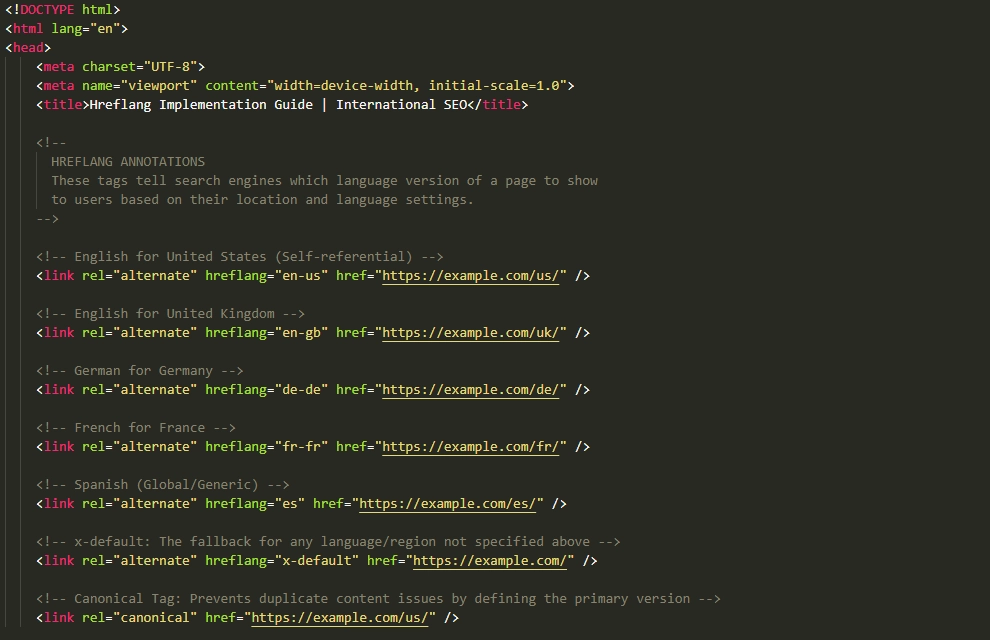
The most widely used approach places hreflang annotations directly in the HTML head section of each page. This is straightforward for smaller sites and works well when you have full control over page templates.
Each page in a language cluster must contain the full set of annotations — pointing to all other variants plus itself. If your site has ten language versions, every page carries ten annotations.
Implementation via HTTP Headers for Non-HTML Files
For PDFs, documents, or other non-HTML files hosted on international subdomains, you cannot add markup to the file itself. Instead, hreflang information can be delivered via the HTTP response headers. This requires server-side configuration and is more technically demanding, but it is the only valid option for non-HTML resources.
Implementation via XML Sitemap
Adding hreflang to your XML sitemap is a scalable alternative that works particularly well for large sites. Rather than modifying individual page templates, you centralise all annotations in one file. Google’s documentation endorses this method, and it is often the preferred approach for enterprise-level international sites.
The sitemap must follow a specific structure, grouping URL sets by page with all language variants listed for each URL.
Manual Implementation vs SEO Plugins
Manual implementation gives you complete control but requires developer involvement. For sites running on WordPress, plugins such as Yoast SEO and Rank Math can automate annotation generation, reducing error risk for non-technical teams.
However, plugins rely on correct configuration. Automated tools can still produce invalid annotations if language settings are misconfigured at the plugin level.
Content Mapping and Planning for Multilingual Sites
Before writing a single annotation, map out your content structure. Identify which pages exist in multiple languages and confirm that each variant genuinely serves a distinct audience. Not every page requires hreflang — applying it indiscriminately adds complexity without meaningful benefit.
A practical content map for a multilingual site might include:
- Homepage variants by region
- Product or service pages localised for language
- Blog posts translated or adapted for specific markets
- Landing pages targeting specific country audiences
- Support or documentation pages in local languages
Hreflang Tags for Different Site Structures
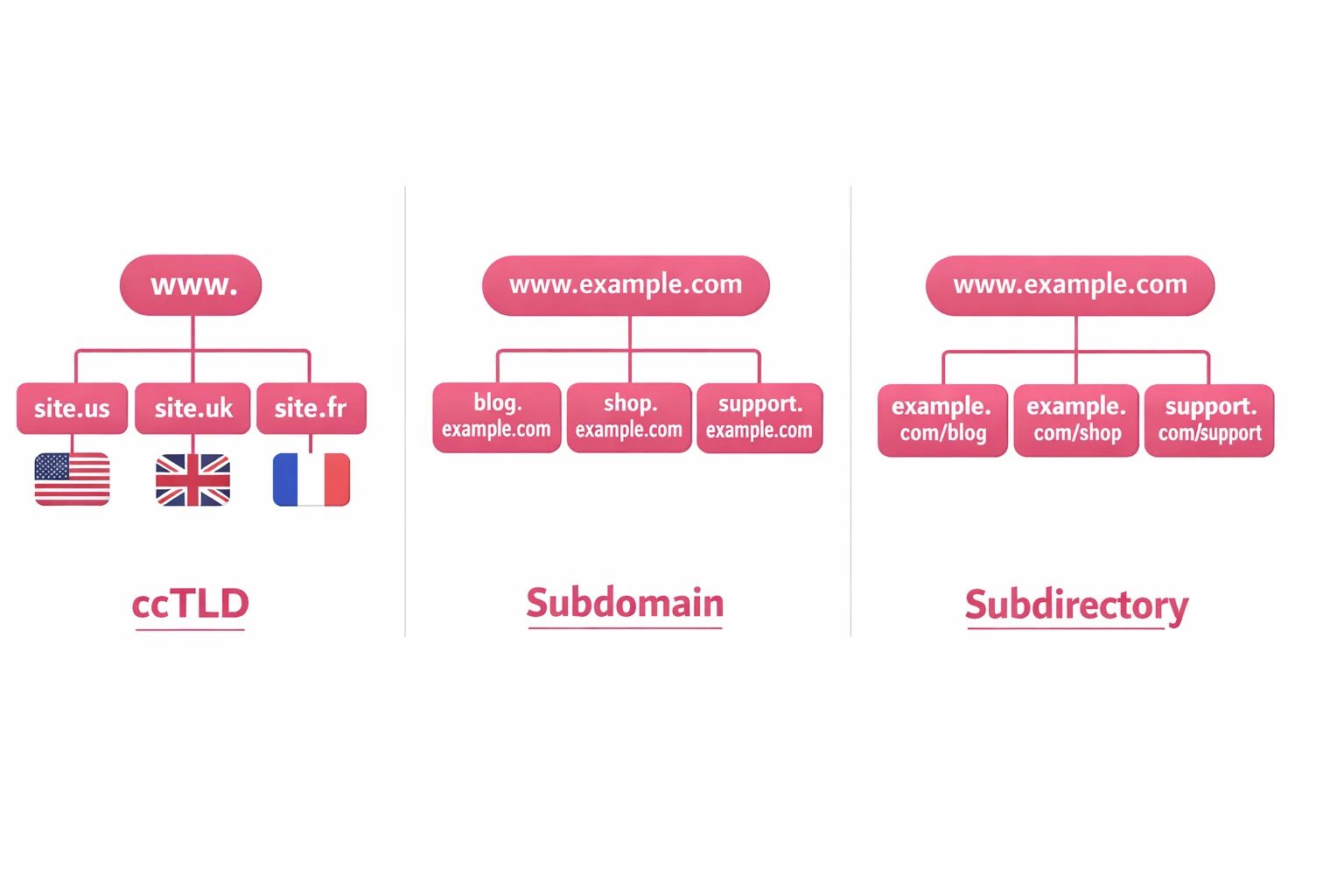
Your site’s architecture plays a major role in how you approach annotation strategy. There is no single correct structure — each has trade-offs related to authority, maintenance, and user trust.
Implementation for ccTLDs
Country-code top-level domains, such as .de for Germany or .fr for France, offer the clearest geotargeting signal. Search engines recognise these domains as inherently regional. Hreflang annotations on ccTLDs reinforce an already strong signal and help when content overlaps between regions.
The main challenge is that each ccTLD operates as an independent domain, requiring separate crawl budgets, link building, and authority development.
Strategy for Subdomains
Subdomains such as de.example.com or fr.example.com offer a middle ground. They allow language-specific content to exist separately while remaining under one root domain. Hreflang is essential here to link related pages across subdomains clearly.
One risk is that subdomains may be treated as separate entities by some search engines, potentially diluting domain authority compared to subdirectory approaches.
Strategy for Subdirectories
Using subdirectories — example.com/de/ or example.com/fr/ — consolidates all authority under one domain. This is often considered the most SEO-friendly structure for international sites that lack the resources to build domain authority across multiple ccTLDs.
Annotations within a subdirectory structure follow the same rules as other implementations but benefit from consolidated link equity.
Handling Country vs Language Variations
Not all international targeting is about language. Some businesses need to target different countries that share a language, such as the US and UK, or Australia and Canada. In these cases, hreflang uses combined codes like en-US and en-GB to distinguish between versions.
The key distinction is that language-only targeting (en) serves all English speakers regardless of location, while combined codes (en-AU) narrow the targeting to a specific geography.
Managing Global E-Commerce and Currency Variants
E-commerce sites often maintain region-specific pages not just for language but for currency, pricing, and product availability. Hreflang can be applied to these variants, but it requires careful coordination. A page serving en-US with USD pricing and a page serving en-GB with GBP pricing should be correctly linked and self-referencing to avoid contradictory signals in search results.
Common SEO Hreflang Issues and Solutions
Even experienced technical SEO teams encounter issues with hreflang. Understanding the most frequent errors speeds up diagnosis and prevents wasted crawl budget.
| Issue | Cause | Solution |
| Missing return links | Page B not referencing Page A | Audit full annotation cluster for reciprocity |
| Annotations on non-canonical pages | Conflict between hreflang and canonical | Always point to canonical URLs |
| Missing self-referential annotation | Oversight during implementation | Add self-referencing annotation to every page |
| Invalid language codes | Typos or unsupported codes | Validate against ISO 639-1 and ISO 3166-1 |
| Annotations pointing to broken pages | URL changes not reflected | Crawl and update annotations after any URL change |
| Multiple pages for same language | Duplicate targeting assignments | Assign each language-region to exactly one URL |
Missing Reciprocal or Return Links
Missing return tags remain the single most reported hreflang problem. If Page A references Page B but Page B does not reference Page A, the entire annotation cluster can be disregarded. Auditing regularly for missing reciprocal links should be part of any international site maintenance routine.
Hreflang Tags Pointing to Non-Canonical Pages
When annotations point to pages with a canonical tag directing to a different URL, the signals conflict. Search engines face a contradiction: the hreflang says “this is the relevant version,” but the canonical says “look elsewhere.” The result is typically that hreflang is ignored. Always ensure annotations point to the canonical version of every page.
Missing Self-Referential Annotations
Every page must reference itself. Without this, search engines may struggle to validate the cluster, leading to inconsistent serving behaviour. This is easily identified with crawling tools and simple to resolve once flagged.
Invalid Language or Country Codes
Typos and unsupported codes are more common than they should be. Using “uk” instead of “gb” for the United Kingdom, or confusing language codes with region codes, causes annotations to fail silently. Validation against official ISO standards before deployment prevents this class of error.
Hreflang Pointing to No-Index or Broken Pages
Annotations pointing to pages with noindex tags or returning error responses create contradictory signals. The engine is being told to rank a page for a specific audience while simultaneously being told not to index it. Regular crawls to check for broken or no-indexed targets within annotation sets are essential.
Multiple Pages Referenced for Same Language
If two different pages both claim to target en-US, search engines cannot determine which is correct and may discard both. Ensure each language-region combination is assigned to exactly one canonical URL across all annotation sets.
How to Check and Evaluate Hreflang Tag Issues

Regular auditing is not optional — it is foundational to maintaining a functioning international strategy. Several tools make this process manageable.
Validation with Google Search Console
Google Search Console provides an International Targeting report that surfaces hreflang errors at scale. It groups issues by type — such as return tag errors or unknown language codes — and provides the affected URLs. This should be checked regularly as part of a standard technical SEO audit cycle.
Auditing with Screaming Frog
Screaming Frog SEO Spider is one of the most widely used tools for technical auditing. Its hreflang tab consolidates all annotations found during a crawl, flags missing return links, identifies self-referencing omissions, and surfaces invalid codes.
For large international sites, combining it with a scheduled crawl routine is highly effective.
Using Hreflang Tag Generators and Testing Tools
Several online generators, including Aleyda Solis’s hreflang tag generator, allow you to build correctly formatted annotation sets before deployment. These reduce implementation errors significantly, especially for teams less familiar with the syntax requirements.
Testing tools such as dedicated hreflang checkers allow you to validate live pages against their reciprocal annotations without running a full site crawl.
Monitoring International Targeting Reports
Beyond error detection, the International Targeting report in Search Console provides data on which countries are targeted and whether there are configuration conflicts. Monitoring this monthly helps catch regressions after site updates or CMS migrations.
Automated Alerts for Hreflang Errors
For larger organisations, integrating auditing into CI/CD pipelines or setting up automated alerts through tools like Sitebulb ensures errors are caught before they affect rankings. Automated monitoring removes the dependency on manual audit cycles, which can be infrequent on complex international sites.
Hreflang Tags Best SEO Practices
Applying hreflang correctly requires consistent habits and attention to detail. These practices separate well-maintained international sites from those that slowly accumulate errors over time.
Use of Absolute URLs in Annotations
Always use absolute URLs in hreflang annotations. Relative URLs may work in some contexts, but they introduce ambiguity that can cause crawlers to misinterpret the target. An absolute URL — including the protocol and domain — leaves no room for confusion.
Consistent Interlinking Between Language Versions
Every page in a language cluster must link to every other version consistently. Inconsistencies — such as some pages missing a language variant’s annotation — break the cluster logic. Use templated implementations to enforce consistency at the code level rather than relying on manual updates.
Proper Coordination with Canonical Tags
Hreflang and canonical tags must agree. If a page is canonicalised to another URL, the annotations on that page should mirror the canonical target. Conflicts between these two attributes produce ambiguous signals and generally lead to hreflang being deprioritised by crawlers.
Inclusion of Hreflang on All Relevant Pages
Applying annotations only to high-priority pages while ignoring the rest creates a fragmented signal. Ideally, every page with a language or regional variant should carry the appropriate annotation. Partial implementation is better than none, but complete coverage produces the most reliable results.
Maintaining Clean HTML Code at Scale
As sites grow, hreflang sets can become unwieldy. A site with thirty language variants carries thirty annotations on every page, adding to page weight. While Google’s documentation suggests that large annotation sets do not significantly harm performance when maintained cleanly, clear and validated code remains important for crawl efficiency and long-term maintainability.
Frequently Asked Questions
Search Console does not update instantly. After fixing common mistakes, it typically takes several crawl cycles — often one to four weeks — before the report reflects the changes. If errors persist beyond that window, you should validate your implementation using Screaming Frog to confirm the annotations are live and reciprocal. Ensure you check every affected URL and verify that your strategy is correctly applied to the version of the page that was recently crawled.
Yes, and it is considered an international seo best practice. Even when the content difference is modest — such as spelling, currency references, or language and location nuances — serving the more relevant version to each audience remains a valid goal. These tags help search engines understand regional intent. Google has not defined a minimum content difference threshold, and the attribute is equally appropriate for pages that differ only in minor regional details to improve your international seo.
Using annotations on pages that redirect users based on their language or IP is technically possible but can create complications. If a search engine crawler lands on an html tag that immediately redirects it away, it may not properly interpret your tags. Additionally, IP-based redirects can prevent users from accessing alternate versions directly, which conflicts with a strong international user experience and seo approach where all alternate versions should remain accessible.
Treat temporary pages the same as permanent ones during their active period. Use a correct setup by including the full annotation set and ensuring a self-referential tag is in place. When the promotion ends, you must ensure that tags pointing to decommissioned pages are removed. Leaving a tag that points to a deleted page is a common mistake that creates noise in your data and can confuse crawlers during an audit of your international search presence.
Adding a large number of attributes to the HTML head section does increase page size, but the impact on users is generally minimal. However, to take your seo strategy to the next level of efficiency, you might consider ways to implement tags via the XML sitemap instead. This way to implement reduces page weight and simplifies template management, especially when managing tags across hundreds of regional variants while maintaining international seo strategy standards.
For images, these annotations are not applicable. However, for PDF files, you can provide information in the http headers. If you maintain distinct language versions of a document, this guide for international seo recommends implementing annotations via server configuration. This ensures the correct version of the page or document is surfaced. Following these seo strategies helps search engines serve the right file based on their language to the global audience.
If the page designated as x-default carries a noindex tag, search engines will not index it, which directly undermines its effectiveness. The x-default destination should always be indexable to ensure tags ensure a fallback for users. If your fallback page is intentionally not indexed, consider if a different target would better suit your comprehensive guide to international seo. A tag pointing back from an indexed page to a noindexed x-default is a waste of crawl budget.
Yes, you can include tags pointing to URLs on entirely separate domains. This is common when using different ccTLDs. As a best practice, all annotations must be reciprocal and point to canonical, indexable pages. Whether you use an html tag or sitemap, the cross-domain nature does not reduce the effectiveness of tags, provided you test and validate the setup. This is a core component of a strong international seo strategy for global brands.