

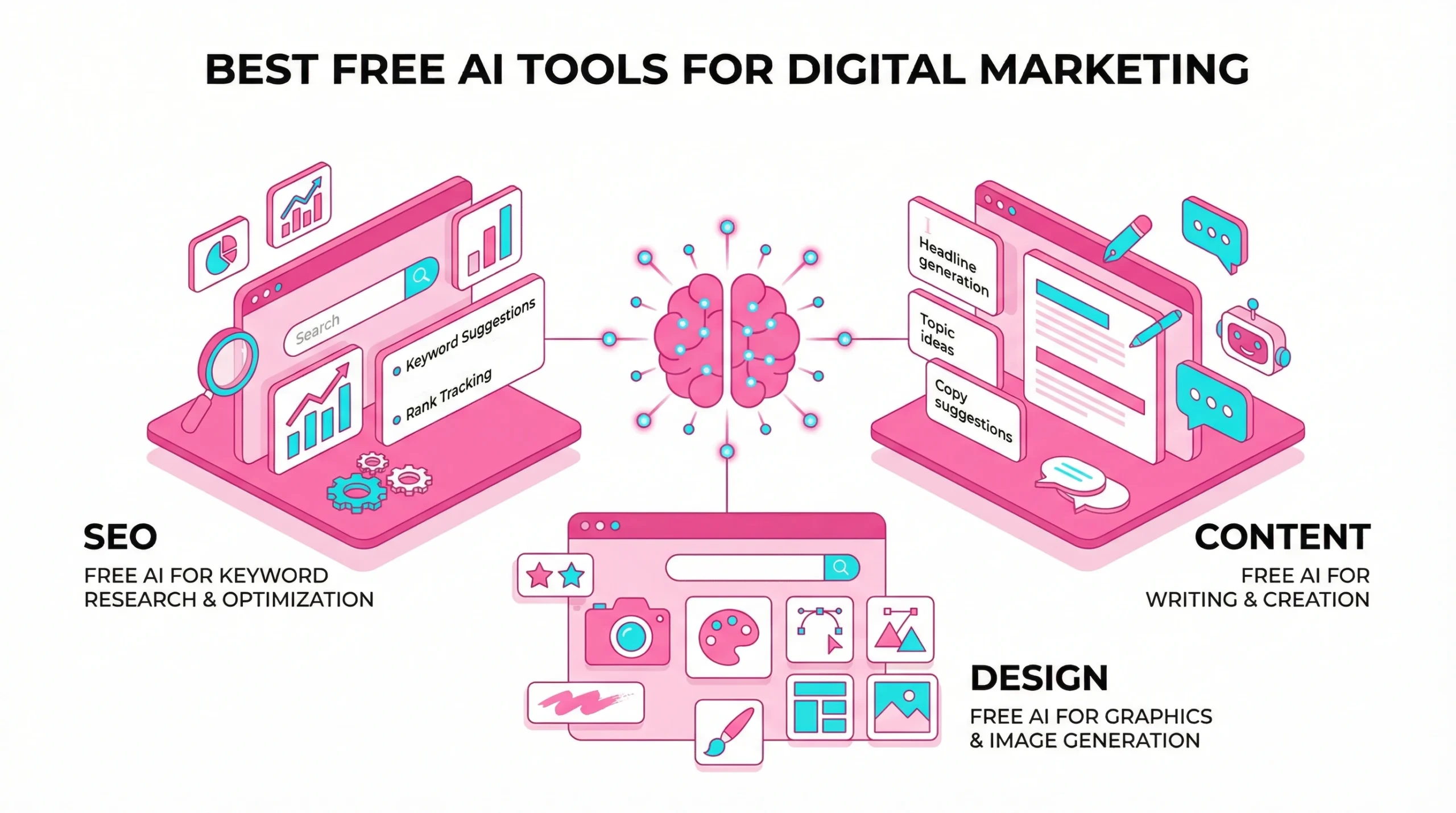
Improve marketing performance for free

Budget constraints no longer have to limit what a marketing team can achieve. A well-chosen set of free tools now puts capabilities once reserved for enterprise budgets within reach of businesses of any size. The challenge today is knowing which tools genuinely deliver and which simply add noise.
Efficiency gains with modern technology
Modern AI systems automate repetitive tasks — drafting subject lines, resizing visuals, generating first-draft blog posts — freeing marketers to focus on strategy. According to McKinsey, companies embedding AI into workflows report productivity improvements of 20–30% on average, even before paid upgrades are considered.
Cost-effective strategies for small businesses
For small businesses, the value is direct. Many free options deliver professional-grade results without requiring a large software budget. A solo consultant or a two-person startup can now run marketing campaigns that compete with much larger teams by assembling the right free stack.
Key areas where free tools create genuine savings:
- Automating scheduling and social media posts
- Generating initial copy drafts in minutes rather than hours
- Analysing keyword trends without expensive subscriptions
- Creating visual assets using zero-cost design tiers
Scaling digital presence without overhead
Scaling used to mean hiring. Today, a thoughtfully selected combination of free and freemium tools can handle significant production volume — letting a lean marketing team grow its digital footprint without proportional cost increases.
Role of AI in marketing
Artificial intelligence has moved from a headline topic to a working part of everyday marketing operations. Its practical applications span content, data analysis, and customer interaction, each offering measurable benefits when applied with clear intent.
Content generation and strategy
AI content tools assist marketers in producing drafts, headlines, and social media posts at volume. They also help shape content strategies by analysing search trends and identifying gaps in existing coverage. This does not replace editorial judgment — it sharpens it by surfacing information that manual research would miss.
Data-driven decision making
Marketing decisions once relied heavily on intuition. AI tools now process large datasets to surface patterns: which ad formats perform best, when audiences are most active, and which messages resonate by segment.
Data-informed approaches allow teams to:
- Prioritise high-performing channels based on evidence
- Adjust spend based on real-time performance signals
- Predict customer lifetime value more accurately
- Reduce wasted budget on low-performing placements
Automated customer interactions
Chatbots and automated messaging tools handle routine enquiries, qualify leads, and deliver personalised responses at scale. This keeps response times short without requiring a proportionally large customer service function.
Definition of AI marketing tools
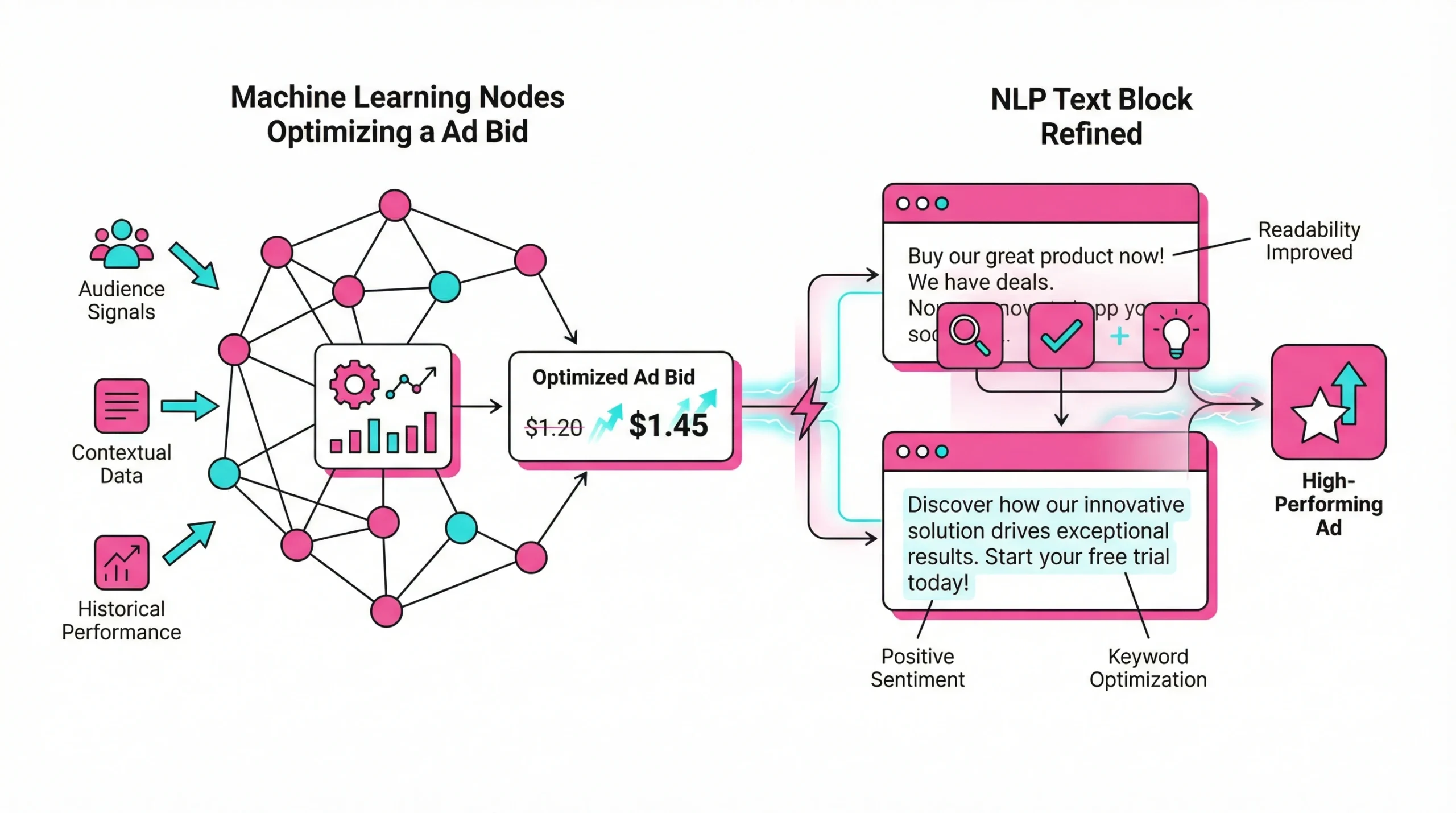
AI marketing tools are software applications that use machine learning, natural language processing, or predictive modelling to assist with marketing tasks. They range from simple writing assistants to complex platforms managing advertising spend autonomously.
Machine learning in advertising
Machine learning models analyse historical campaign data to optimise bidding, targeting, and creative selection in real time. Platforms like Albert.ai use this approach to manage ad spend across multiple channels simultaneously, adjusting decisions faster than a human team could.
Natural language processing for copy
NLP enables tools to understand context, tone, and intent in written language. This powers applications from grammar checkers to AI copy generators, helping marketing teams refine messaging and maintain consistency at scale.
Predictive analytics for consumer behavior
Predictive models use past behaviour — purchase history, browsing patterns, email engagement — to forecast what a customer is likely to do next. Marketers use these forecasts to time campaigns more precisely and personalise messaging at the individual level.
Top free AI marketing tools to grow business in 2026
The market now offers a broad range of tools with functional free tiers. The list below covers the most useful options across key marketing disciplines, from writing and design to analytics and outreach.
Claude for versatile marketing tasks
Claude is a capable AI assistant for drafting blog posts, summarising research, generating creative briefs, and supporting content strategies. Its free plan supports meaningful daily use across a wide range of content tasks.
- Key Advantages:
- Natural language processing for human-like drafting.
- Advanced reasoning for complex strategy briefs.
- Effective summarization of extensive market research.
- Website: https://claude.ai/
Surfer SEO for content optimization
Surfer SEO analyses top-ranking pages and provides guidance on structure, word count, and keyword usage. The limited free version is sufficient for exploratory audits and early-stage content planning.
- Key Advantages:
- Real-time competitor content analysis.
- Structured guidance for SEO-friendly writing.
- Data-backed keyword density recommendations.
- Website: https://surferseo.com/
V0 for website building
V0 by Vercel generates working front-end components from plain-language prompts. Marketing teams can prototype landing pages and campaign microsites quickly without dedicated developer resources.
- Key Advantages:
- Instant generation of UI components using React/Tailwind.
- Fast iteration for landing page mockups.
- Accessible interface for non-technical team members.
- Website: https://v0.dev/
Google Labs for experimental features
Google Labs houses experimental products from Google, including AI-assisted search and browsing tools. It is completely free and gives marketers early visibility into how AI search engines are evolving — useful for shaping future search strategies.
- Key Advantages:
- Early access to Search Generative Experience (SGE).
- Experimental productivity and research modules.
- Direct insight into future search algorithm shifts.
- Website: https://labs.google/
Kling AI for video production
Kling AI generates short video clips from text prompts. Its free tier produces usable content for social media posts and product demonstrations without requiring video editing skills.
- Key Advantages:
- High-quality video rendering from simple text.
- Ideal for social media teasers and B-roll content.
- User-friendly generation process for fast results.
- Website: https://klingai.com/
Notion AI for workspace productivity
Notion AI sits inside a widely-used workspace tool. It summarises meeting notes, generates action items, and drafts project briefs — all within a collaborative environment that most teams already use.
- Key Advantages:
- Direct integration with team documentation.
- Automated extraction of action items from meetings.
- Instant content drafting within a shared wiki.
- Website: https://www.notion.so/product/ai
Jasper AI for professional copywriting
Jasper AI specialises in marketing copy, from email marketing sequences to ad headlines. Its 30-day free trial gives teams time to assess fit before committing to a subscription.
- Key Advantages:
- Specialized templates for ads and sales funnels.
- Brand voice settings to maintain consistency.
- Time-saving batch generation of marketing hooks.
- Website: https://www.jasper.ai/
Lexica Art for visual assets
Lexica Art generates high-quality images through a search-and-generate interface. Its free plan includes a set number of monthly image generations, suitable for testing and low-volume creative work.
- Key Advantages:
- Large database of prompts for artistic inspiration.
- High-fidelity image generation for digital assets.
- Simplified interface for quick visual creation.
- Website: https://lexica.art/
LALAL.AI for audio processing
LALAL.AI separates audio stems — useful for producing podcast clips, marketing videos, or branded audio content. A free plan covers limited processing minutes per month.
- Key Advantages:
- Precise separation of vocals and background noise.
- Professional-grade stems for video production.
- Simple drag-and-drop cloud processing.
- Website: https://www.lalal.ai/
Crayo for short-form video trends
Crayo automates short-form video creation, including captions and transitions. It is particularly valuable for teams producing content at volume for platforms like TikTok or Instagram Reels.
- Key Advantages:
- Trend-optimized video templates.
- Automatic captioning for high engagement.
- Fast export of multiple social media clips.
- Website: https://crayo.ai/
Brandwell for SEO blog automation
Brandwell generates long-form SEO blog content with built-in quality checks. It is designed for teams that need to produce consistent, search-optimised content without scaling their writing headcount.
- Key Advantages:
- Scalable creation of detailed, rank-ready articles.
- Integrated plagiarism and AI detection scans.
- Optimized structures for search engine visibility.
- Website: https://brandwell.ai/
Originality AI for quality assurance
Originality AI checks content for AI patterns and potential plagiarism. For teams using multiple AI content generation tools simultaneously, this adds an essential quality layer before publication.
- Key Advantages:
- Accurate detection of AI-generated content.
- Robust plagiarism scanning against billions of pages.
- Fact-checking assistance for improved reliability.
- Website: https://originality.ai/
Writer for team collaboration
Writer is a team-oriented AI writing platform. It stores brand guidelines, approved terminology, and style rules — ensuring consistent output across every member of a marketing team.
- Key Advantages:
- Centralized brand voice and terminology enforcement.
- Secure workspace designed for corporate privacy.
- Collaborative editing with AI-driven style checks.
- Website: https://writer.com/
Undetectable AI for content refinement
Undetectable AI rewrites AI-generated text to read more naturally. It is designed for teams polishing automated content before publishing, though editorial review should always follow any automated rewriting.
- Key Advantages:
- Human-like rewriting for better flow.
- Adjustment of text readability levels.
- Reduces robotic patterns in raw AI outputs.
- Website: https://undetectable.ai/
ContentShake AI for blog ideation
ContentShake AI, by Semrush, combines keyword research with AI writing suggestions. It surfaces blog topics likely to rank and provides outline guidance based on live search data.
- Key Advantages:
- Topic ideation based on real-time search trends.
- End-to-end workflow from keywords to outlines.
- Direct data integration from the Semrush ecosystem.
- Website: https://www.semrush.com/contentshake/
Fullstory for digital experience tracking
Fullstory records user sessions and surfaces friction points on websites. Marketing teams use it to understand where visitors drop off and optimise pages based on actual behaviour rather than assumptions.
- Key Advantages:
- Visual session replays to identify user issues.
- Heatmaps and interaction tracking.
- Friction-point detection for UX improvements.
- Website: https://www.fullstory.com/
Hemingway App for readability
The Hemingway App highlights complex sentences, passive voice, and readability issues. It is free to use in-browser and quickly improves the clarity of any marketing copy.
- Key Advantages:
- Instant readability score and visual highlighting.
- Free web-based tool for quick text refinement.
- Reduces jargon and improves copy directness.
- Website: https://hemingwayapp.com/
Chatfuel for automated messaging
Chatfuel builds chatbot flows for Facebook Messenger and Instagram. Its free plan supports basic automated customer interactions, lead capture, and responses to frequently asked questions.
- Key Advantages:
- Visual builder for automated messenger funnels.
- 24/7 automated customer support and lead gen.
- Easy integration with social media platforms.
- Website: https://chatfuel.com/
Grammarly for editing and tone
Grammarly checks grammar, spelling, and tone across written content. Its free version handles most editing needs, while the paid plan adds deeper style suggestions and brand tone settings.
- Key Advantages:
- Advanced grammar and spell check in real-time.
- Tone detection for appropriate professional communication.
- Cross-platform support across browser and desktop.
- Website: https://www.grammarly.com/
Albert.ai for ad campaign management
Albert.ai uses machine learning to manage and optimise digital ad campaigns autonomously. It is suited to teams managing spend across search, social, and display simultaneously.
- Key Advantages:
- Autonomous budget reallocation for better performance.
- Machine learning for audience segment discovery.
- Real-time creative optimization for ad units.
- Website: https://albert.ai/
Paradigm AI for market research
Paradigm AI assists with synthesising qualitative research quickly. It is useful for marketing teams conducting customer interviews or analysing open-ended survey data at scale.
- Key Advantages:
- Rapid synthesis of customer feedback and interviews.
- Identification of recurring themes in raw data.
- Reduction of time spent on manual research analysis.
- Website: https://paradigm.ai/
Userbot.ai for managing conversations
Userbot.ai automates conversations across multiple channels. It routes queries, handles common requests, and escalates complex issues — reducing manual handling time for support and sales teams.
- Key Advantages:
- Unified conversation management across channels.
- Smart routing of customer support requests.
- AI-driven responses that learn over time.
- Website: https://userbot.ai/
Browse AI for web data extraction
Browse AI scrapes public web data without requiring code. Marketing teams use it to monitor competitor pricing, track brand mentions, or pull product information for comparison content.
- Key Advantages:
- No-code data extraction from any website.
- Automated monitoring and change alerts.
- Scalable lead generation from public directories.
- Website: https://www.browse.ai/
Algolia for search experiences
Algolia powers fast, relevant search experiences on websites and apps. Its free plan handles meaningful query volume and supports personalisation features useful for content-heavy sites.
- Key Advantages:
- Instant search results with typo tolerance.
- Personalized results based on user interactions.
- High-speed infrastructure for site-wide navigation.
- Website: https://www.algolia.com/
PhotoRoom for product photography
PhotoRoom removes backgrounds from product images and adds clean, professional backdrops. The free version handles individual images and is widely used by e-commerce marketing teams.
- Key Advantages:
- Instant background removal with pixel precision.
- Library of high-quality backdrops for product ads.
- Optimized for e-commerce and social commerce needs.
- Website: https://www.photoroom.com/
Reply.io for email assistance
Reply.io automates outbound email sequences, follow-ups, and A/B testing. Its AI features help draft initial messages and suggest optimal send times based on engagement data.
- Key Advantages:
- Automated multi-step outbound sequences.
- AI-assisted drafting of cold outreach emails.
- Performance tracking and A/B testing tools.
- Website: https://reply.io/
Brand24 for social listening
Brand24 tracks mentions of your brand, competitors, and relevant keywords across social networks and the open web. Its trial period provides a clear picture of current online sentiment.
- Key Advantages:
- Real-time social media sentiment monitoring.
- Identification of industry influencers and ambassadors.
- Custom alerts for brand-specific keyword mentions.
- Website: https://brand24.com/
Influencity for creator partnerships
Influencity helps brands identify and manage influencer relationships. Its free plan includes limited search access across a broad creator database — useful for initial research.
- Key Advantages:
- Extensive influencer database with niche filters.
- Basic audience demographics for initial screening.
- Streamlined influencer campaign management.
- Website: https://influencity.com/
Canva for graphic design
Canva is one of the most widely used design platforms available. Canva’s AI features — including its text-to-image generator and background remover — are accessible on the free plan, making professional visual production fast and accessible for non-designers.
- Key Advantages:
- AI-powered “Magic Studio” for image generation.
- Thousands of professional templates for every format.
- Fast visual production without specialized design skills.
- Website: https://www.canva.com/
AnswerThePublic for keyword research
AnswerThePublic visualises search questions around any topic, organised by question type. Its free plan offers a limited number of daily searches, sufficient for regular content ideation and blog planning sessions.
- Key Advantages:
- Visual map of real customer search queries.
- Identification of “Who, What, Why” intent patterns.
- Effective tool for mapping long-tail content ideas.
- Website: https://answerthepublic.com/
Here is a quick reference for the tools covered above:
| Tool | Primary Use | Free Access |
| Claude | Writing and research | Free plan |
| Surfer SEO | Content optimisation | Limited free |
| Jasper AI | Copywriting | 30-day trial |
| Grammarly | Editing | Free plan |
| Canva | Graphic design | Free plan |
| Brand24 | Social listening | Trial |
| AnswerThePublic | Keyword research | Free (limited) |
| PhotoRoom | Image editing | Free plan |
| Chatfuel | Chatbot automation | Free plan |
| Hemingway App | Readability | Free in browser |
| Browse AI | Web data extraction | Free plan |
| Reply.io | Email sequences | Free trial |
Criteria for choosing best free AI marketing tools
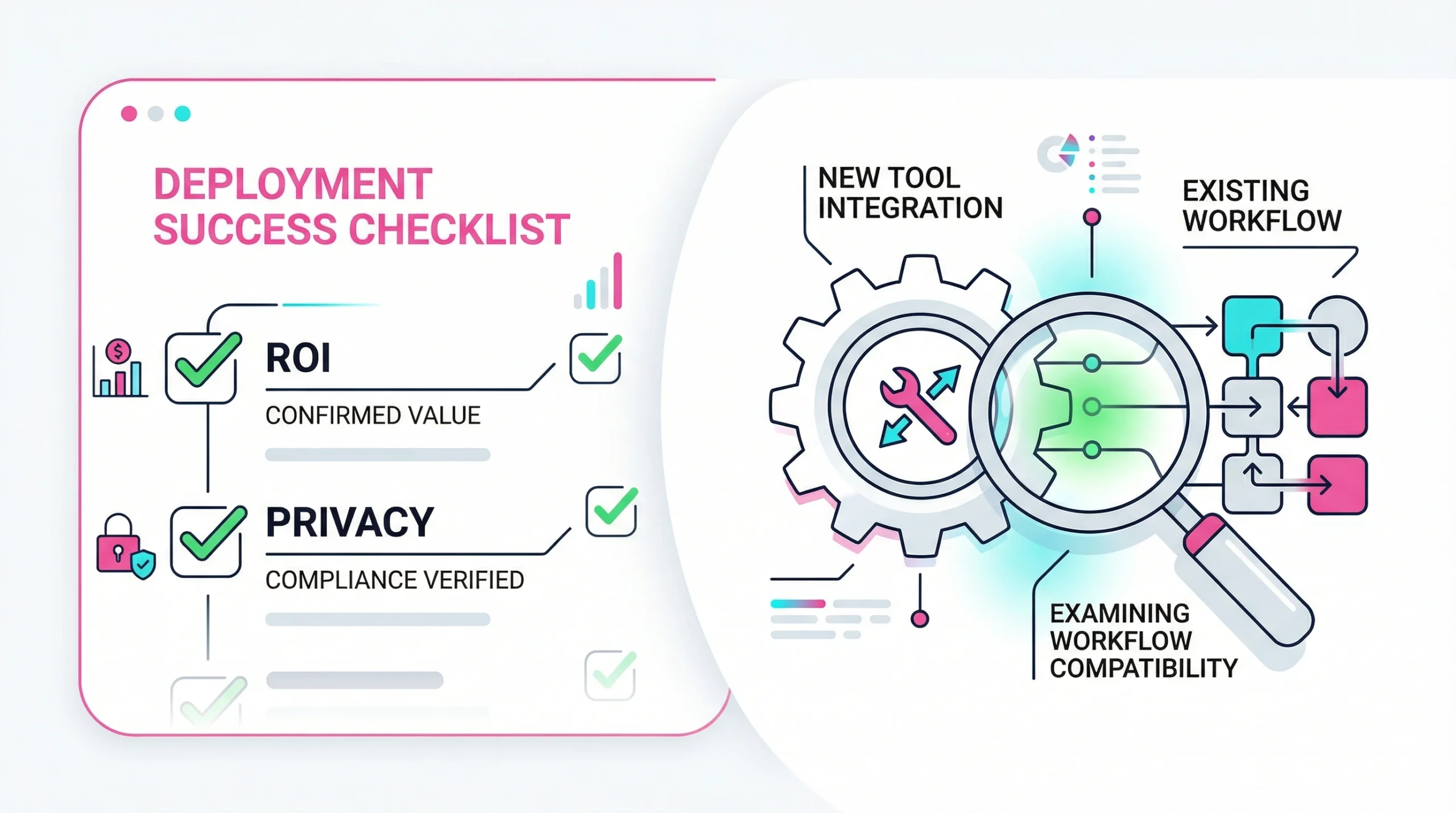
Choosing thoughtfully matters more than choosing quickly. A tool that solves a genuine gap in your workflow delivers more value than one with impressive features you will never use.
Assessing functional requirements
Start by mapping your current marketing process and identifying where time is lost or quality is inconsistent. Match tools to those specific problems rather than to general enthusiasm for new technology.
Questions worth asking before selecting any tool:
- Does this address a documented bottleneck in our current process?
- Can we measure the impact of using it?
- Does the free tier offer enough functionality to assess value before upgrading?
- Is it maintained and actively developed?
Evaluating ease of integration
A tool that does not connect with your existing systems creates more work than it saves. Look for native integrations with platforms you already use — your CRM, email marketing service, or social media management platform.
Key integration questions:
- Does it connect to your CRM via API or native integration?
- Can it export content directly to your CMS?
- Is there a Zapier or Make connector available?
- Does the free tier support team access?
Checking data privacy standards
Any tool processing customer data must meet your legal privacy obligations. Review terms of service carefully, particularly for tools handling email lists, CRM records, or website visitor data. Data processing agreements should be in place before any customer data enters a third-party system.
Free vs paid AI marketing tools comparison
The gap between free and paid tiers varies significantly across tools. Understanding it early helps you plan upgrades strategically rather than reactively.
Feature limitations in free tiers
Most free plans cap usage volume — monthly queries, image generations, or exported files. They often restrict advanced features like team collaboration, API access, or custom brand voice settings. These limits are intentional, designed to encourage upgrades as your needs grow.
Scalability and support differences
Paid plans typically include priority support, higher usage limits, and features built for teams working at volume. As your marketing output increases, these differences compound quickly.
| Factor | Free Tier | Paid Tier |
| Monthly output limits | Low to moderate | High or unlimited |
| Team access | Often single user | Multiple seats |
| Customer support | Community or email | Priority or dedicated |
| Advanced features | Core functionality | Full feature access |
| Data retention | Limited history | Extended retention |
| Brand customisation | Basic | Full brand settings |
Determining ROI for premium upgrades
Calculate the time saved against the subscription cost before upgrading. If a paid plan saves five hours of manual work per week, and your team’s time has real opportunity cost, the return often justifies itself within the first month.
Implementation practices for marketers
Having the right tools is only part of the equation. How you implement them determines the actual impact on your marketing efforts.
Setting up efficient workflows
Map each tool to a specific stage of your content or campaign process. Avoid functional overlap — two tools performing the same task adds cost and confusion. Document which tool owns which step so the entire team follows consistent processes.
A practical workflow example:
- Use AnswerThePublic for initial topic and question research
- Draft outlines and briefs in Notion AI
- Write first drafts using Claude
- Improve sentence clarity with the Hemingway App
- Check grammar and tone consistency with Grammarly
- Design supporting visuals in Canva
- Schedule and distribute via your social media management tool
Balancing automation with human creativity
AI tools accelerate production, but brand voice, strategic framing, and genuine audience empathy still require human input. Treat every AI output as an informed first draft — not a finished piece.
Measuring impact on conversion rates
Connect tool usage to measurable outcomes from the start. If you introduce an AI email subject line tool, track open rates before and after. If you apply a readability checker consistently, monitor time-on-page and bounce rates. Measurement keeps your stack justified and prevents accumulating tools that do not actually move results.
Common mistakes when using AI in marketing
Even experienced teams fall into predictable patterns when they first adopt AI tools at scale. Awareness of these mistakes makes them easier to avoid.
Over-reliance on automated outputs
Publishing AI-generated content without human review risks factual errors, off-brand tone, and messaging that feels generic. Automated outputs are starting points. They benefit from the context, judgment, and experience that only human editors bring.
Neglecting brand voice customization
Many tools generate competent but neutral text by default. Without clear brand guidelines, audience personas, and style preferences built into your prompts, the output will lack the specific voice that differentiates your business from competitors.
Practical steps to maintain brand voice:
- Create a short style guide tailored to each AI tool you regularly use
- Include explicit tone examples and audience descriptions in every prompt
- Review all outputs against a brand consistency checklist before publishing
- Assign one person responsibility for maintaining prompt templates across the team
Ignoring data privacy and ethical considerations
Using AI tools to process personal data without reviewing their privacy policies creates legal and reputational exposure. The General Data Protection Regulation and equivalent frameworks in other regions apply to how you handle data inside third-party tools. Data processing agreements must be in place before any customer information enters an external system.
Future of AI in digital marketing
The tools available today represent an early version of what is coming. Several trends are already shaping how the next generation of marketing technology will work.
Emerging trends for 2027
Multimodal AI — tools that process text, image, audio, and video together — is becoming more accessible. Marketing teams will increasingly produce cross-format campaigns from a single brief. AI search engines are also changing how content is surfaced, favouring structured, well-cited, and authoritative sources over volume-driven approaches.
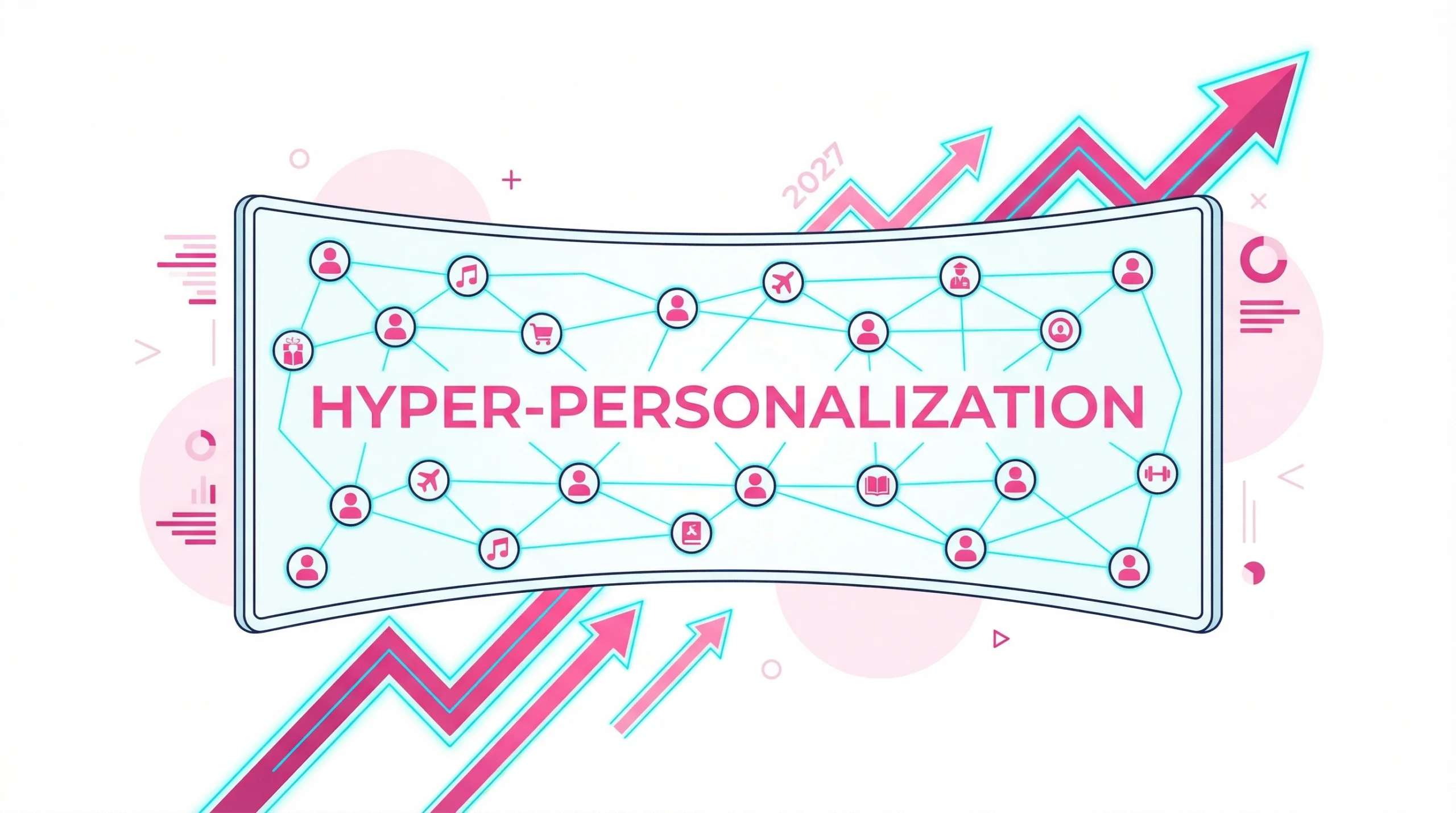
Hyper-personalization at scale
AI will increasingly enable personalisation at an individual level, not just a segment level. Email sequences, website content, and ad creative will adapt based on individual behavioural signals in real time.
For marketers, this means investing early in first-party data strategies. Building audience understanding through your own channels gives AI tools meaningful signals to act on — something third-party data can no longer reliably provide. The teams that will benefit most from these advances are those building first-party data foundations today, rather than waiting for the tools to mature.
Frequently asked questions
Both tools perform well for long-form content, but they have distinct strengths — Claude tends to produce more nuanced, structured prose with stronger contextual coherence across longer pieces, while ChatGPT’s broad training makes it versatile across different tones and formats. For SEO content specifically, neither tool replaces a dedicated optimisation layer like Surfer SEO or ContentShake AI, and combining an AI writer with an SEO analysis tool typically produces stronger results than relying on either alone.
The answer depends on each platform’s specific terms of service, which vary and can change without notice, so you should always verify directly on the tool’s site before publishing commercial work. Lexica Art’s current terms permit commercial use of generated images, but the broader caution applies around intellectual property — AI image tools trained on large datasets may occasionally produce outputs that resemble existing works, making it good practice to review generated images carefully before using them in paid or branded advertising.
A functional free marketing stack is achievable by pairing tools strategically across key disciplines — AnswerThePublic for research, Claude for writing, Canva for design, Grammarly for editing, Chatfuel for customer interactions, and Brand24 or Google Alerts for monitoring. The main constraint you will encounter is usage volume, since most free plans cap the number of monthly actions, which means working within those limits requires batching tasks, prioritising high-impact work first, and upgrading only when a specific, documented bottleneck justifies the cost.
AI-assisted tools like AnswerThePublic surface patterns in search behaviour quickly and at a scale that manual research cannot match, but they do not replace the strategic judgment involved in evaluating keyword difficulty in context, understanding nuanced search intent, or identifying the genuine needs of a specific audience. These tools are most effective when used to expand and organise initial research directions, not as a complete substitute for a considered keyword strategy developed by someone who understands the competitive landscape.
The primary risk is publishing content that lacks accuracy, originality, or genuine value regardless of whether it reads as human-written, because search engines increasingly evaluate content quality through user engagement signals rather than text pattern detection alone. There is also a brand credibility risk: if audiences identify published content as formulaic or shallow, trust erodes in ways that are difficult to reverse. Tools designed to obscure AI origins do not resolve underlying quality issues, and relying on them without thorough editorial review tends to produce diminishing returns over time.
Consistency across multiple design tools requires a documented visual identity system — including colour codes, typography rules, logo usage guidelines, and image style preferences — that you apply manually when setting up each new tool. Some platforms like Canva allow you to save brand kit elements even on the free plan, which helps significantly, and for tools without dedicated brand settings, a shared reference document that team members check before finalising any output provides a workable alternative that costs nothing to maintain.
Free tools from Google, including experimental products available through Google Labs, offer strong foundational capabilities — particularly for search behaviour analysis and basic performance tracking — and for most small to mid-sized marketing teams these tools cover the majority of day-to-day analytical needs. The gap versus premium platforms becomes meaningful primarily when teams need to consolidate data from many different sources, run advanced statistical models across large datasets, or require dedicated implementation support, which are needs that tend to emerge as organisations scale rather than from the outset.
E-E-A-T — Experience, Expertise, Authoritativeness, and Trustworthiness — is evaluated through content quality and demonstrated credibility rather than through the specific tools used to produce content, so using AI assistance does not directly harm these assessments. What does affect E-E-A-T is publishing inaccurate, generic, or unreviewed content, and the distinction matters: a marketer who uses AI tools to draft content and then substantially edits, fact-checks, and adds genuine subject-matter expertise can produce high-quality work that performs well, while content published without that editorial layer may underperform regardless of which tool created it.